I love that Anne calls the very first draft of what writers write as “shitty first drafts”. I love it not because I write shitty first drafts and then better second drafts, but because I only write shitty first drafts, and then hit publish.
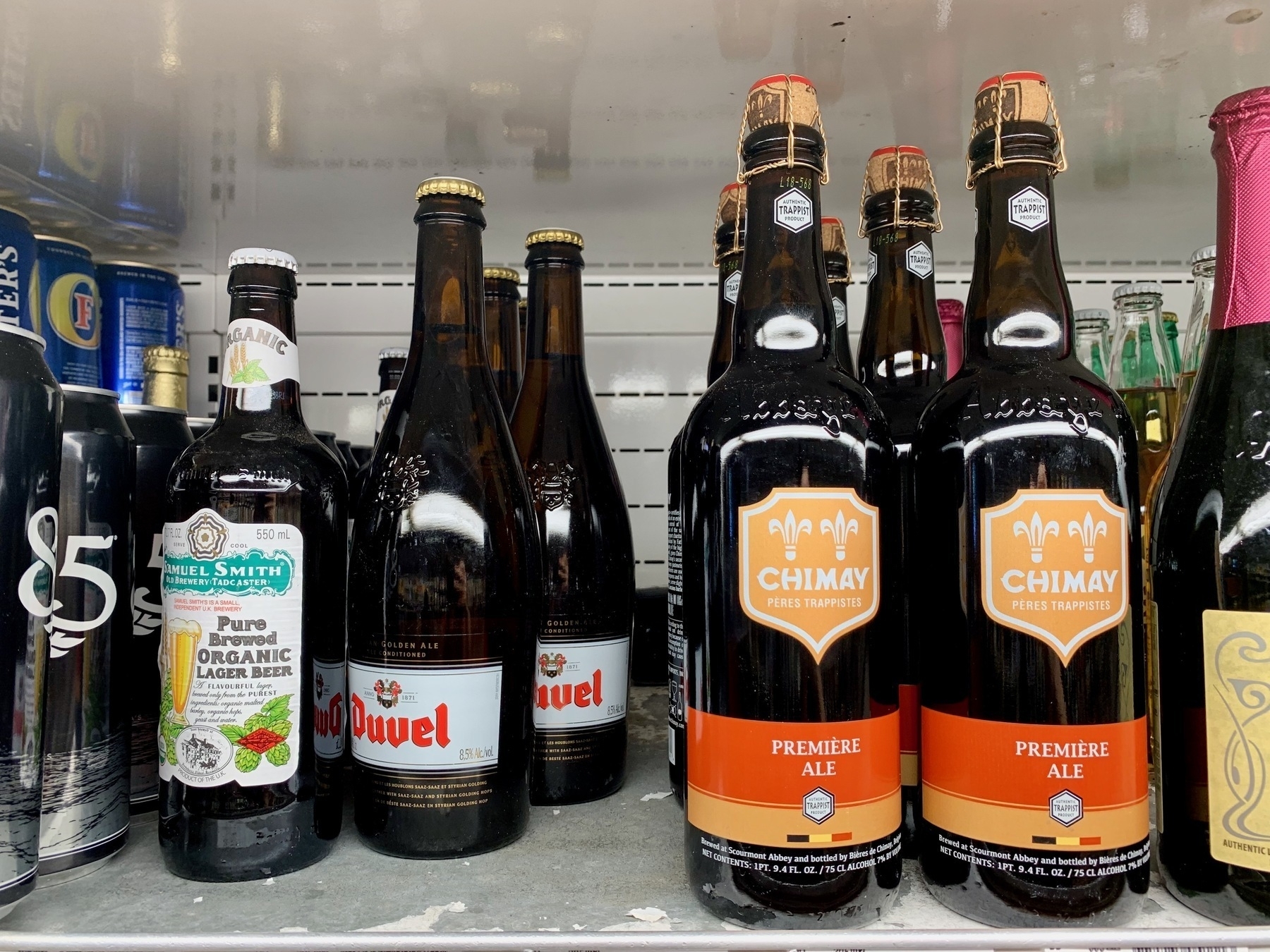
Duvel would certainly have been my favorite beverage if it weren’t for the existence of coffee. It’s hard to come by in DC, so imagine my delight when I found it at a random grocery store in Maui.
Humans are represented by a mass of 70 kg and a radius of 50 cm (we assume sphericity), while whales are represented by a mass of 10^5 kg and a radius of 7m.
The sun flares up the sky over Lake Mead, then at a record low (note the white strip just above the water), which was soon to be broken.
Lake Mead, NV, September 8 2021.
I don’t hide my disdain for Eric Topol, and of course one has to wonder whether professional jealousy plays a role; he is, after all, a high-profile doctor with thoughts about technology. But this morning I found an excellent counterfactual in Peter Attia who is slightly closer to me in age, moves in high-profile circles, and spends time “creating content” about what I think is a bit of a time-waster for rich people: prolonging lifespan healthspan. In other words, he carries the perfect confluence of properties to create even more disdain on my part; and yet, I think that overall he is an upstanding guy who is smart, no-nonsense, and great at communicating complex ideas.
This was a long-winded intro to my recommendation for today’s episode of EconTalk, which has confirmed my priors and reminded me that it’s never too early in the week to call Topol a hack. Him and Attia are so similar on paper, so different in reality.
September 24, 2023
A mural from the rust belt. Obscured by the gas-guzzlers in the bottom left corner is the slogan: “Without Labor Nothing Prospers”. Indeed.
Athens, OH, 2021.
September 23, 2023
Is a rainy day in the life of a cat really different than any other day?
While assembling slides for the UMBC clinical trials course I’m helping with, I was reminded that Richard Doll and A. Bradford Hill never received the Nobel Prize for medicine despite conclusively showing by the way of a new-fangled method called a prospective cohort study — it was the late 1950s — that tobacco kills. They both did the work in their early middle age and lived into their 90s, so it’s not like they didn’t make it to see their work validated (like, say, Oppenheimer not being there for the confirmation of his black hole theory). Of course, the committee is not infallible — they did hand out the prize to a lobotomist — but the errors of omission are so much worse.
My same slide deck also mentions Barry Marshall and Robin Warren who (deservedly!) won the medical Nobel for another disease pathogenesis discovery: they showed that the helicobacter pylori bacterium — and not stressful living, bad thoughts, lack of dietary milk and butter, or whatnot — is responsible for gastritis. Marshall conclusively proved this by ingesting the bacteria himself back in 1985; the Nobel Committee was impressed enough by this feat of IRB avoidance to hand him and Warren the prize — in 2005, the year of Dr. Doll’s death!
I hate to sound intellectually vacuous but choose to get more done. At the relevant margins, get more done. Life : culture / peers will routinely tell you it is OK to get less done and you should politely insist on getting more done. The amount of doneness you get is not fixed.
I have been thinking along these lines ever since reading, some dozen years ago, an article about a particularly successful cystic fibrosis center, whose outcomes were an order of magnitude better than average. This was before any new drugs or promising trials were available, and the only reason why they were so much better was that they did more of everything: more frequent follow-up, more intensive manual therapy, more changes to treatment regimen with subtle changes in condition, less complacency.
Nowhere is this more evident than on the inpatient service. It is incredibly easy to coast with reflexive and defensive medicine, putting out small fires like hospital-acquired infections or patient falls, passing on the buck to the next team, shrugging your shoulders about that 60-year-old with questionable CHF (or is it COPD/asthma) exacerbation who is not following the script and doesn’t seem to be getting any better despite being treated for everything. Patients hang around a bit longer, suffer a bit more iatrogenesis, die a bit sooner, not enough for it to be obvious in any particular case but just enough for the outcomes to be worse in aggregate.
Make no mistake: this is how many (most?) American hospitals operate, for the simple reason that there simply aren’t enough doctors and nurses around for the level of attention sick patients with many active complex disorders deserve. But doing more is the American ethos (see the X-post above); not being able to provide more focused care, we dig into the seemingly infinite supply of more drugs, more procedures, more iatrogenesis to which to expose patients, making their condition all the more complex.
Outside of medicine, this is also the difference you can see in “good” and “bad” (for collaboration) institutions: good ones throw water at embers before they become a fire, communicate more frequently and openly, do not leave documents for review “for after the long weekend”. They do more; or rather, each individual there does more and does not pass on the buck to forces unknown which are beyond their control (and the bigger the institution is, the more numerous and more complacent those forces are; incredible how that works). The not-so-good institutions also do more: of emailing, usually, to tell you that something can’t be done.
So yes, choose to get more done, and also make sure you are doing more of the right thing.