The mantra at the end of this back-to-school themed Washington Post column — please drive safely, please drive safely, please drive safely — should have an addition: and don’t look at your G-d damn phone. We’ve had a couple of near-missed walking through DC; each time it was because the driver was too busy texting to pay attention to the intersection.
Kudos to @danielpunkass for making MarsEdit idiot-proof. I was writing a long-ish text this morning and while uploading the photo the app crashed, an unsaved post disappeared, and my heart sank. But on restart, everything was still there. Phew! ❤️
Wildwood Crest beach. The appropriate word is 'expansive'.
The colors aren't Victorian, but I'm sure the darkness and dampness inside are.
The Wildwood beaches are ridiculously large. It’s as if someone took a super-sized Costco and made it into a beach. You can have a “beach access” house and still need to walk 15 minutes to get to the ocean, two thirds of that being a walk across the sands.
At least the sand is packed tight! Great for walking and castle-building, and I hope it’s less prone to a deadly collapse because I’ve never seen so many families spend their beach time just diggin' holes — and not even that close to the water in an attempt to make a pool. What is the purpose of it? What are they expecting to find?
Too bad that it’s still the ocean… I have been forever spoiled by the mild Mediterranean seas, never mind the exorbitant prices and the overcrowding.
Morey’s Piers — the Mariner’s Pier in particular — are better run and more fun than anything in Atlantic City. Which, duh, of course it would since one is clearly geared towards adults with “family fun” somewhat of an afterthought, but this was a confirmation.
I was genuinely surprised by the amount of pro-Trump T-shirts on display in every boardwalk store. There was a mug shot T-shirt on sale less than 24 hours after his arraignment. No one on the boardwalk wore any of them, though I did see quite a few “I ♥︎ hot guys” shirts.
A different type of an amusement park is the town of Cape May, which is apparently a Victorian bed & breakfast bonanza. I’ve lived in 100-year-old house, and it’s not what it’s cracked up to be, but maybe the feeling is better when you know it’s not your own place and you’re just there for a vacation? Still, they are pretty on the outside.
And all of this in less than 4 hours of driving from DC! The key is to leave on a Monday morning.
So, if anyone asks what the default affordable beach holiday should be, my vote is probably for the Shore over OBX if you’re in it for the beach and the attractions, the other way around if you prefer the activities; but as the designated driver I really can’t discount that one is half the driving distance of the other. Jersey Shore wins.
The company was close to bankruptcy when Jobs returned, and the iMac gave the company a cash infusion that allowed it to complete work on Mac OS X, rebuild the rest of the Mac product line in the iMac’s image, open Apple Stores, make the iPod, and set the tone for the next twenty five years.
I’m currently reading The Dao of Capital, which is all about the Austrian school of economics and the roundaboutness of true entrepreneurs, and this made what Apple is doing even more salient. Can you name a more roundabout tech company than Apple?
To be clear, I suspect little of this was premeditated in the long term — i.e. no, Jobs and Ive probably did not have a Vision Pro in mind as the ultimate goal when they thought of the iMac — but the ethos of seeing everything as a potential intermediary and not commoditizing it fully à la Samsung is very much the Apple way. Using the iMac as the intermediate step towards the iPod, which was itself an intermediate step towards the iPhone, which was supposedly to be an intermediate step towards the iPad but turned into something much greater, though it also did end up being an intermediate step towards Apple silicone, all the while peppering these intermediary products with technology — LiDAR, ultra-wide lenses, spatial audio — that would become the key building blogs of Vision Pro, which is itself an intermediary towards who knows what. Very Austrian.
Thinking more closely to home, I can think of a few biotech companies that may be doing something like this — maybe, if you squint — but none come close. The addiction to immediate profits that the distorted American health care market provides is much too great.(↬Daring Fireball)
August 24, 2023
National Harbor, MD is a cute mixed-use development just south of DC anchored by a casino, a convention center, and a ferris wheel; but it is most certainly not Washington, DC, the 5,000 residents of NH having representation in Congress, 700,000 of those in DC being without. These District turf wars are a tiny bit less parochial than they seem.
Imagine if all of your favorite writers recorded their own audio versions of Stephen King’s On Writing.
That’s what this show is about.
It’s like Chef’s Table for writers. We go behind the scenes to uncover the meta-mechanics of writing, the lifestyle behind it, and all the ways you can make money at your keyboard. By learning how your favorite writers work, you’ll see your own creative process with fresh eyes.
The emphasis is mine, and between how over-produced the show looks and Perell’s Monetize-It! ethos it could not have been less than a match for me. But then he got the Marginal Revolution duo as his first set of guests, so give it a chance I will.
By the way, at what point do we stop calling them podcasts and start calling them YouTube shows with an audio-only track?
Happy 20th birthday to the Marginal Revolution blog, by the way. I remember the first post I saw — an assorted link list featuring a memorable bear-hiker interaction — but of course it is now impossible to find thanks to MRs rudimentary search. It is a blog, through and through.
August 22, 2023
This weeks’s Galaxy Brain from Charlie Warzel, about the apparent decline of Wirecutter, is spot on:
Wirecutter’s trajectory is the story of what the internet does to most great ideas: It forces them to scale, and then others replicate the concepts at varying levels of quality until, eventually, an economic, algorithmic wildfire is burning. The original is consumed and left in a scarred landscape.
Not just the internet, I would say. It’s the American way of doing everything!
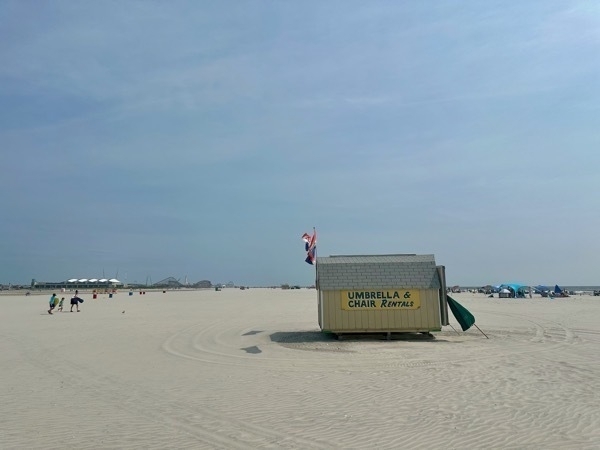 Wildwood Crest beach. The appropriate word is 'expansive'.
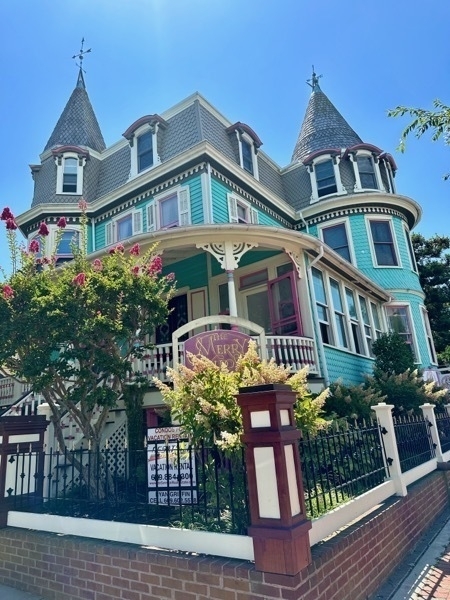 The colors aren't Victorian, but I'm sure the darkness and dampness inside are.