And for those of you who love to sneer at “consumerism,” let me repeat a story I have told before. A Cuban woman, a recent refugee, entered a supermarket in Miami and proceeded to burst into tears. Surrounded by such a dazzling display of goods, her heart broke, she said, when she thought of the people she had left behind in Cuba, who had so little.
But, why do the people in Cuba have so little, Martin, why?
Snark aside, his perspective on being an immigrant to the United States is close to mine; the entire column is worth your time.
Four months after switching to Edge, it is still going strong as my default browser. The Bing sidebar is now the first thing I turn to with questions about code of any kind (the last two examples: how to assign the current screen width to a variable in AppleScript, and how to create custom color gradients for a heat map in Mathematica; the first one it got in the first try, we needed three attempts for the second). The compose pane has seen less use â my day job requires less BS generation than I originally feared â but is still a marvelous tool for writer’s block prevention: just knowing it can produce text-on-demand makes my own words flow to compete.
Add vertical tabs, split window panes, web app creation, bookmarklet support (while some other Safari competitors refuse to acknowledge that bookmarks â yes, bookmarks, even exist), and did I mention it was fast? It will take a lot to switch to something else.
For the first time this century, Microsoft has my full attention.
I have always admired prolific writers like Matthew Yglesias and Scott Alexander — both now on Substack, and not by accident — for their ability to produce tens of thousands of words daily,
My admiration being tampered somewhat by ChatGPT and other LLMs, which are about as intellectually and factually rigorous as Alexander, and slightly less so than Yglesias; some sacrifices do have to be made in the name of productivity. on top of the random bite-sized thoughts posted on social media. There are only so many words I can read and write in a day, and for the better part of the last year, my language IO has been preoccupied by helping clean, analyze, interpret, and write up the results of a single clinical trial, which are now finally out in The Lancet Neurology.
Yes, my highest impact factor paper to date is in a neurology journal. Go figure.
The paper is about our clinical trial which used the body’s own immune system to treat autoimmune disease — and a particular one at that, myasthenia gravis — via technology that up until now has only been used against cancer (CAR T cells). It has made a decent impact since it came out less than two days ago. It got a write-up in The Economist, for one. Endpoints News as well. Evaluate Vantage got the best quote — it is at the very end of the article. And there is a whole bunch of press releases: from National Institutes of Health, University of North Carolina, Oregon Health and Sciences University, and of course Cartesian Therapeutics.
What went on yesterday reminded me that Twitter is not going anywhere any time soon: all of the above releases were to be found only there, not on a Mastodon instance, the journal’s own media metrics do not — and can not, at least not easily — trawl the Fediverse for hits, and I can’t just type in “Descartes–08”, “myasthenia gravis CAR-T”, or “Cartesian” into a Mastodon search box and get anything of relevance.
One could, of course, argue that you wouldn’t get anything of relevance on Twitter either, most of the discussion consisting of people who have barely read the tweet, let alone the article. And one would be correct. And while most of the non-Web3/crypto tech world has moved out, it looks like people in most other fields, from medicine to biotechnology to the NBA commentariat, are maintaining substantial Twitter presence.
This will, of course, have no impact on my commitment to staying out of the conversation to the extent possible while maintaining a semi-regular schedule of 500-character posts, which may now, IO bandwidth having opened up, become a tiny bit longer. Thank you for reading!
“Phil [Lord] does have good ideas. He speaks creatively really well, and listening to Phil can be inspiring. But the process is not inspiring.”
Sure, if it were that easy then everyone would do it, but there are no excuses for making people around you feel tiny.
June 21, 2023
Tyler Cowen talked to Noam Chomsky, and the result was so much like his conversation with Jonathan (GPT) Swift that I wondered if it was a prank Tyler pulled using, I don’t know, a ChomskyBot? Be a “public intellectual” long enough and you become a parody of yourself.
Chris Arnade’s travelogue from Senegal (Part 1, Part 2) is well worth your time, especially if you can also spare a minute to read Tyler Cowen’s notes from Kenya and a Masai village. To put the two in (somewhat uncharitable) contrast:
This past weekend there was a conference at the fanciest resort in Dakar, the one with its own golf course. The title was something like, “Solving all of Africa’s problems, 2023!” and representatives of various global non-profits, charities, and NGOs were flown in to spend four days talking about what Africa needs. Presumably something only they and their friends can offer.
Verus:
Kenya Is Poised to Become the ‘Singapore of Africa’
June 20, 2023
It is time to abolish Kindergarten graduations. What exactly are we celebrating here, and how low are we setting the bar for future festivities?
For my non-American audience: yes, this is a thing, with toddlers all dressed up and ready to receive their diploma. Pure madness!
June 19, 2023
Tyler Cowen had a “fireside chat” about Effective Altruism. Every trade conference I go to has “fireside chats” with “industry leaders”.
The fireside chats were a series of evening radio addresses given by Franklin D. Roosevelt, the 32nd President of the United States, between 1933 and 1944. […] On radio, he quelled rumors, countered conservative-dominated newspapers, and explained his policies directly to the American people. His tone and demeanor communicated self-assurance during times of despair and uncertainty.
Michael Bonner is the anti-Harari: the history he writes about is narrower in scope and more precise, the present more grounded in reality, the future less bright — unless we work hard for it. He will not be speaking at Davos.
Washington Post’s Katherine Ellison on the striking decrease in mortality from lung and breast cancer in the US:
There are many and varied explanations for the progress, says Memorial Sloan Kettering oncologist Larry Norton, including “better early diagnosis, better imaging, better blood tests, better preventive measures and better treatments, including precision medicine with gene-profiling of patients’ tumors.”
The rest of the article focuses on treatments — immunotherapy in particular —
And yes, of course dostarlimab was mentioned. Once a darling, always a darling. and cancer survivorship, but in discussing decreasing deaths from lung and breast cancer the article missed an opportunity for some education in cancer epidemiology.
The two sources chosen to present these data, ASCO’s cancer.net for lung and Breastcancer.org for breast are lacking in two ways: they are an impenetrable wall of text without much context, and they both have an agenda. Now, it happens that I agree with ASCO’s agenda — I am a dues-paying member — and don’t know enough Breastcancer.org to form an opinion, but neutral parties they are not. If only there was a tax-funded, publicly available database which could help us visualize trends in cancer statistics.
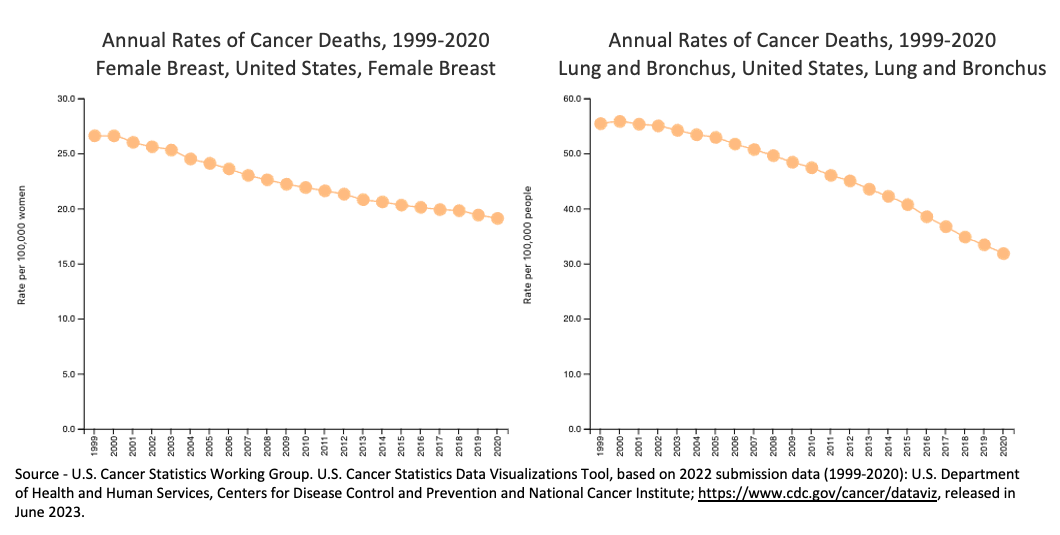
Now it so happens that the CDC maintains such a database, with its very on visualization tools, and it is exactly what we need. It will even make your PowerPoint slides for you! And yes, deaths from both lung and breast cancer have been steadily decreasing for the past two decades.
Lung and female breast cancer mortality in the United States, 1999–2020.
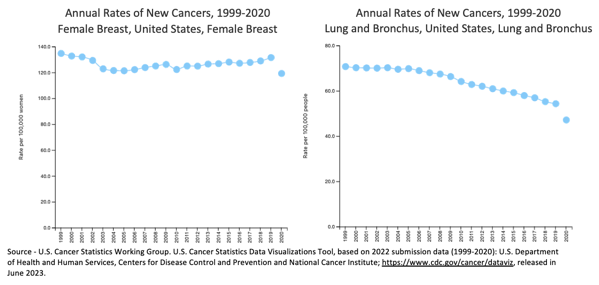
But is it because of better prevention, early diagnosis, more effective treatments, or all three? Looking at cancer incidence — the number of newly diagnosed cases per year — may help some. Better prevention would lead to decreased incidence, early detection would lead to an increase, a combination of the two may cancel each other out leading to a flat line, and any change in treatments would not affect it at all.
Lung and female breast cancer incidence in the United States, 1999–2020.
A slight initial dip in female breast cancer incidence followed by an even slighter increase make me think that early detection — all those mammograms — is superimposed on better prevention. The case is less ambiguous for lung cancer: the incidence is plummeting. In both cases, “prevention” was initiated by the 1964 Surgeon General’s report on tobacco smoke which led to massive anti-smoking campaigns from the 1970s onwards. The results weren’t immediately obvious — not having to air out all your clothes after a night out notwithstanding — but cancer rates started dropping after 20 years, and 50 years later we are reaping the full benefits.
Note that in lung cancer the mortality slope is steeper than the incidence slope. And while this may be explained by early detection and better treatments, it is possible that at least some of the improvement over newly diagnosed lung cancers is due to non-smoking associated lung cancer being generally less aggressive and occurring in younger and healthier people than tobacco-associated cancers. What could help unravel these different components — and highlight the increasing importance of cancer survivor healthcare — would be a prevalence curve: how many people in the United States are currently living with a particular cancer. Alas, those data are not available.
If you thought interpreting those four curves was interesting, do go back to the CDC database and check out the incidence and mortality curves for thyroid cancer — that poster child of over-diagnosis — and prostate cancer, the incidence of which fluctuates ever which way with changing screening recommendations but with mortality marching downwards for the last 20 years.