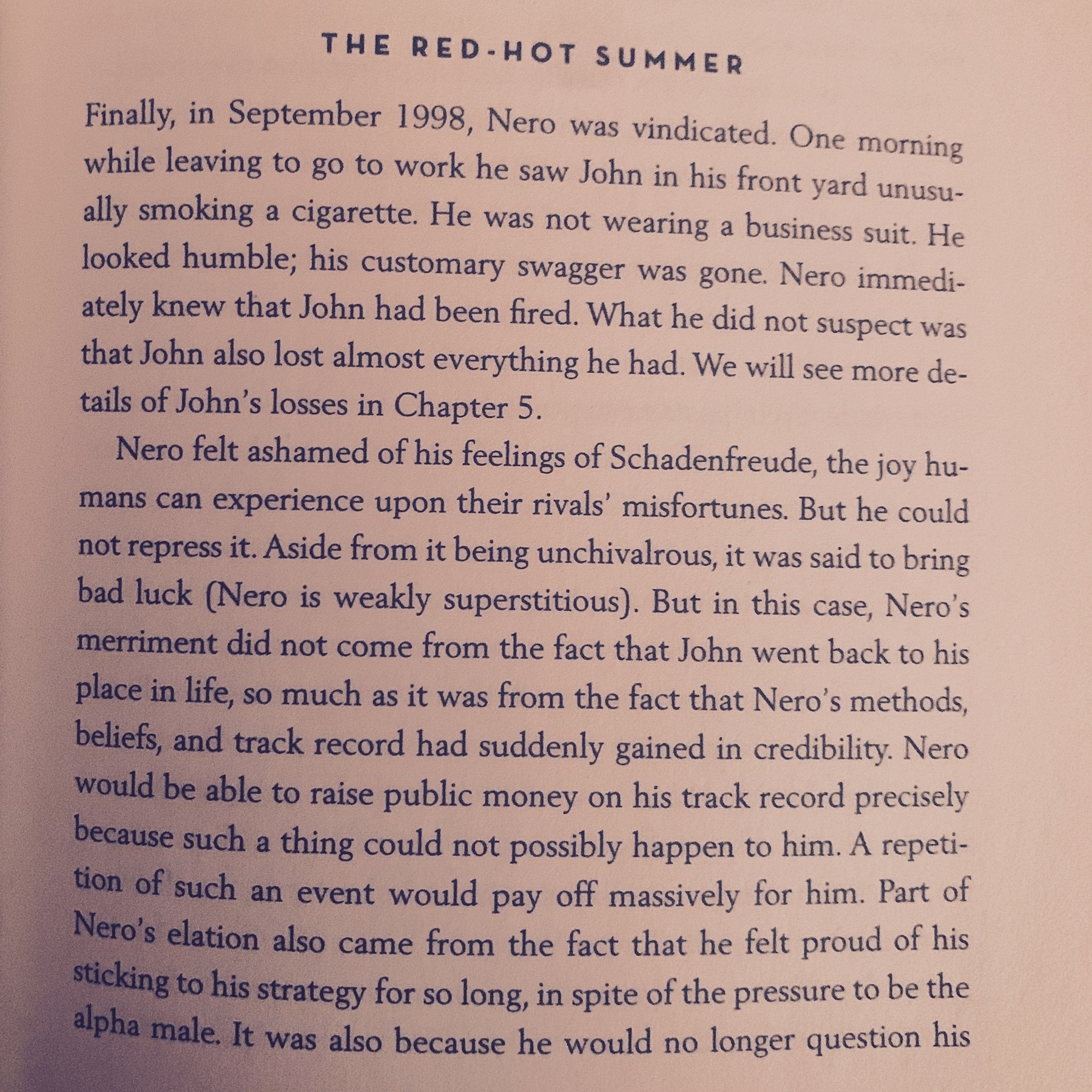
📚 Taleb the prophet, writing about cryptobros and the summer of 2022 back in the early 2000s.
Financial instruments come and go but human stupidity and greed are forever.
July 1, 2022
Give a lecture once and you help a few hundred people (if you’re lucky). Post the lecture to YouTube and you help millions. 7 years later, I am yet to find a better guide to academic writing.
NB: it’s good to have a live audience.
June 30, 2022
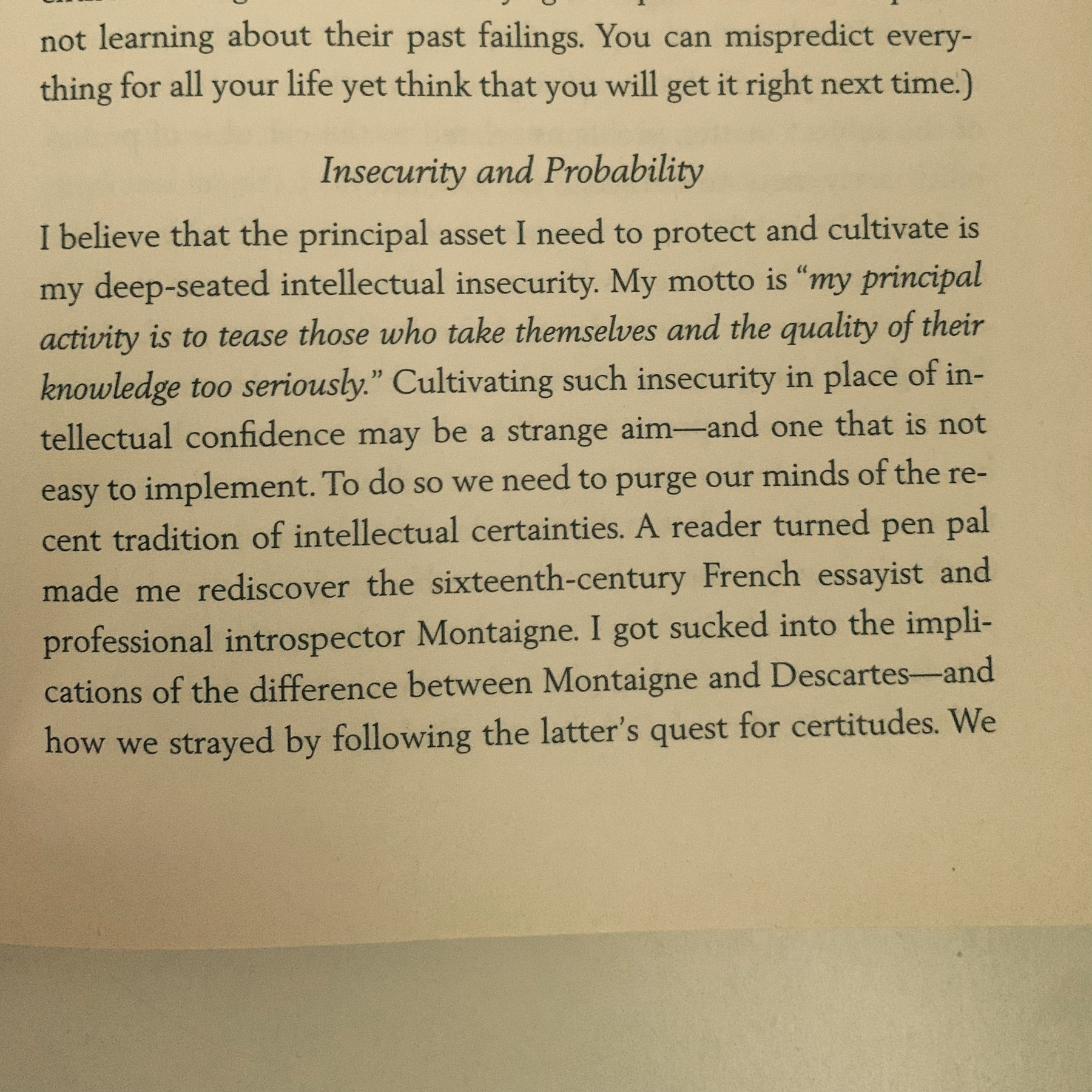
📚 Re-reading Taleb’s Fooled by Randomness for the first time since covid hit. From the preface, on intellectual immodesty. There is a direct line from this to the catastrophic early response to the pandemic.
BTW, our company is called Cartesian but we are Montaignes at heart.
June 29, 2022
“Whether hot or cold water freezes faster remains unknown.”
Thus begins a wonderful Quanta Magazine article about the “Mpemba effect”, named after a Tanzanian teenager who saw something funny happen to his home-made ice cream. Reality is complicated.
June 28, 2022
“A lot of people simply won’t read a 15-page whitepaper, but will be impressed by flowcharts. By making the language of Web3 meandering and impenetrable and by building a culture that is very self-referential, investors make criticism harder to come by.”
Today’s Galaxy Brain newsletter is about Web3, but replace “whitepaper” with “manuscript” and “investors” with “researchers” and you get bad science in a nutshell.
June 26, 2022
“If you are trying to figure out a thinker and his or her defects, see if you can spot that person’s “once-and-for-all” moves. There will be plenty of them.”
Cowen is right, though we can debate whether early closure is a defect or a feature.
A town that has more art deco than brutalism — the largest piece of concrete in sight was a modestly sized skate park — is my kind of town. It is at once frozen in time (picture unsupervised tweens riding bicycles and scooters down a quiet tree-lined street) and progressive (in the American sense of having more crystal shops than chain stores and more rainbows than stars’n’stripes posted on storefronts).
The same cannot be said about another picture-perfect town, Frederick, which is distinctly unlike its home state of Maryland. Note, however, that only one of these two states had segregation of some kind in this century. It is also, for someone who has spent the last 12 years in the Baltimore-DC area, noticeably white, but note more so than would be expected from any place in North Carolina.[^one]
Biltmore is as impressive as you would expect a 250-room house to be, but also shows how much better our lives are compared to the richest of the early 20th century rich. Yes, your 23,000-book library with wall-to-wall and floor-to-ceiling bookcases is beautiful, but even a person living on the street has access to more books than that from a device in their pocket. Never mind the demands of heating, cleaning, and maintaining the beast. No wonder then that the owners turned it into an amusement park instead of continuing to live there.
A few more observations:
Farm Burger is a Southern fast food chain a few notches above Shake Shack that in addition to pretty good beef and incredible vegan burgers also serves roasted bone marrow. The only thing missing was sweetbreads.
There are too many hills for it to be a biking town yet there were many people on bicycles. Having mostly narrow, slow-traffic streets downtown helps.
There are not one but two interstate highways that bisect the city, but unlike Baltimore’s idiotic I-83 that destroyed many neighborhoods and ruined the city’s walkability, there are plenty of ways to cross the I-240 on foot. Here, having hills actually helped as the highway is in many places nestled between two slopes.
Its largest neighbors are Knoxville (approx. 2 hours away), Charlotte (same) and Atlanta (3 and a half). That is… too far away for too little, perhaps?
But was the 7+ hour drive from DC worth it? Hell, yes.
“This contains a combination of various life-extension medicines (metformin, ashwagandha, and some vitamins), and covid defense gear: a CO2 meter… masks, antigen tests and fluvoxamine.”