Spider-verse meets Gravity falls, resulting in a completely unexpected delight that really is fun for the whole family. The animation is beautiful, the pace is fast, the humor earnest and often physical, and the story intentionally misses every opportunity for cynicism. The photogenic family next door with the perfect vacation photos really is that high-functioning, fit and smart.
Some Eastern European cynicism is in order, though: given that these characters are voiced by John Legend and Chrissy Teigen, making them inauthentic frauds was never an option. Friends are there to support you, not tease you. The world doesn’t make fun of weirdness, it embraces it.
So, even though it premiered on Netflix, this is not your ordinary Netflix feature-length animation; it is actually good. It is also a triumph of believable character motivation and well-executed action sequences over a coherent plot. Thankfully, humans put much more weight on the former.
At the very beginning, David Epstein presents a dichotomy: there are the super-specialists, who decide early on in their lives who they are and what they want to be, and put all of their time and energy into improving a narrow set of skills that make them competitive in a tightly-regulated field such as professional sports; and then there are the generalists, who try out different things here and there, learning across disciplines and using that knowledge to solve difficult — “wicked”, the book calls them — problems that don’t fall neatly into any category, but which are more and more common in our modern world full of complexities.
The model super-specialist is Tiger Woods, who picked up his first golf club as a toddler and won his first tournament at age six. Compare and contrast with the model generalist, Roger Federer, who dabbled in 11 different sports
Squash, skiing, wrestling, swimming, skateboarding, basketball, handball, tennis, table tennis, badminton, and soccer. before finally picking up the one that will make him famous at the ripe old age of (checks notes)… eight.
The rest is of the same cloth: light on arguments, heavy on emotion. The examples of hyper-specialization it gives are telling: oncologists specializing in cancer related to a single organ and interventional cardiologists.
Apropos interventional cardiologists, Epstein attributes the massive overuse of stents for dubious indications to the said specialists “getting so used to treating chest pain with stents … that they do so reflexively”. And not because of financial incentives? Interesting. Never mind that to get to any medical subspecialty one needs to go through more than 20 years of not so specialized schooling, sample different professional careers in college, then sample different physician specialties in medical school, and not reach the subspecialty until their early thirties at best. When did the supposed generalist Roger Federer start playing tennis, again?
So, the term “specialist” gets thrown around a lot without being precisely defined. Is it the narrowness of one’s current field that makes them a specialist? Or is it the path they took to get there? Regardless, we do know what makes a generalist: meandering from field to field until you find your niche, which will, ideally, use some of the knowledge and skills gained through all of that meandering. If you start as a stocker at Walmart, then work as a florist, hair stylist, hand model for a watch company, and end up as a short order cook at McDonalds, well that’s not much of a generalist story. Flip these around so that your final job is something more glamorous and you are the master of your profession who uses the Walmart work ethic, florist’s sense of proportion and beauty, Mickey D’s sense of urgency, and a hand model’s way with wrist movements to create a work of coiffured art. It’s the narrative and Texas sharpshooter fallacies combined.
Their friends confirmation and survivor bias also show up. Each chapter has a few stories hand-picked to showcase how a “generalist” solves problems that the “specialists” were stumped with. The generalist’s life story is then picked apart to showcase their versatility, though some at first do not appear to be so versatile. There are, unfortunately, no counterfactuals, and no going over the specialists’ biographies which would — I am fairly confident — be strikingly similar to those of the generalists.
Looking back at a life, your own or someone else’s, is very much like stargazing. There are a few set pieces — a marriage here, a near-death experience there — but for the most part the events are devoid of much meaning until we give it to them by imputing a causal relationship to something that is important ex post. Epstein picks out situations where a failing team of “specialists” — let’s take him at his word that they are, for their biographies are not presented and we are left wondering whether they, too, worked the summers in their family’s farm or had a brother in the concrete business or some such — well, where that team of maybe-specialists is rescued by a certified (by Epstein) generalist who expresses their generalissimo-ness via a string of anecdotes, the stars in my overwrought stargazing analogy.
There is a story to be told about narrowness of focus and the importance of not being a fachidiot. Epstein comes tantalizingly close to framing the problem as it should be framed: that specialty narrow-mindedness — no matter how you got to it — is dangerous and makes you a bad specialist and a worse human. Yet there is no mention of this wonderful German word in the book’s hundreds of pages. That’s too bad: Fachidiocracy would have been a better title.
Reading primary literature is superior to press releases and tweets — it sounds so obvious, but not many physicians act on it. There no prizes to be won for not just following the KOLs[^kol],
Key Opinion Leaders, the influencers of medicine before influencer became a real noun. Note that unlike the influencers of social media KOLs don’t use the #sponsored hashtag, though there is a hashtag equivalent. nor do you save any time. Quite the opposite: instead of a promoted tweet about the me-too drug de jour falling into your lap, you need to find a way to identify what’s worth your time reading, and also find time to actually read it — not a small achievement, as highlighted by the above tweets.
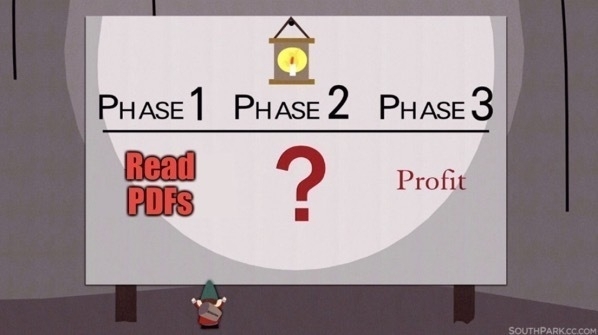
But then what? Sure, there is profit at the end of the rainbow in the form of useful knowledge, but merely reading a PDF may not result in any knowledge at all, let alone knowledge you can use. Or, as the [underpants gnomes][gnomes] would put it:
I too had a backlog of unread PDFs once, spent so much time organizing files and folders, using this and that program to store the metadata,
NB: if you write any sort of scholarly texts you will still need a reference manager, no matter what system of organizing PDFs themselves you choose. I recommend Zotero, lest your institution has a requirement for Endnote (which must have quite a salesforce, to so thoroughly insert their buggy, laggy, slob of a program into every academic crevice). trying out plain paper, a Kindle, an iPad or two, thinking it is how I was reading them that mattered and oh if only I could find the perfect setting, under the shade of an old oak tree perhaps, with some peace and quiet, a pen in one hand and a cup of coffe in the other, well, then the unread pile would melt away and all would be good in the world.
But reading is easy, if what you read is useful, entertaining, or both. For most people without visual impairments or dyslexia, the log jam is at Step 2. We don’t want to read our pile of PDFs because, in most post-GME circumstances, there isn’t a clear goal to reading them (lest you have superhuman memory).
The clear exception here being board exam and MOC prep, where the goal is obvious and the sources of information are all spelled out. This is particularly true early on in your carreer, when you have nothing to hang your hat on mentally, and few connections to make between what you are reading and what you already know. Sure, you don’t need to keep track of the articles you’ve read if the only reason for reading is to pan them on Twitter. You do, however, want to summarize what you’ve read and save it for future use, be it in a lecture, article, grant proposal or a blog post. So if and when you find a fairly obscure but potentially important fact about this or that cellular pathway in a supplemental figure from a CNS-adjacent journal, and you memorize the fact for later use, and then a year or so later you do use it to make a figure for the background section of a clinical trial protocol, well, what you do not want happening in that case is to spend hours of your life trying to retrace your steps and figure out the original source when a fellow
Yes, this has happened to me. We do have good fellows. asks where you got the data.
As with most of the things I do it is too personal and Rube Goldberg-y to be of use to anyone else, but it started with a forum post and a book, and if you’d like to turn your plate full of PDFs into something more usable may I recommend that you start with one or both of those and see how it goes. Could it be any worse than what you’re doing now?
Interstellar is many things: a mediocre sci-fi story, a timely study of sociopathy, a schmaltzy meandering about love conquering space and time, an excellent showcase of near-future space engineering, and, sadly, a big budget Hollywood movie that grossly underestimates its audience.
I have yet to see Tenet but from what I have heard about its convoluted and unknowable plot, it is Christopher Nolan’s reactive formation to the many comments about oversimplifying and over-explaining that followed Interstellar. For an ever better example of a reactive formation see La La Land as Damien Chazelle’s response to Birdman winning the best movie Oscar over Whiplash and giving the Academy what it wants: more cotton candy navel-gazing. Ironic that the attempt also failed to win, this time to a better opponent.Foreshadowing is one thing, having one astronaut do the punch-a-hole-though-a-folded-piece-of-paper schtick to another while they are in space on their way to a wormhole as part of a billion dollar secret mission… Well, that’s a whole new level of cringe.
Hollywood rears its head in many other places, most of all the needless addition of superficial suspense to things that don’t need added suspense. Because a father communicating with his estranged daughter through spacetime is not emotional enough, let’s also add a hick brother who doesn’t want her at the only place where communication is possible, and may kick her out at any moment. Decades are spent on trying to get humans off Earth, yet the big scientific breakthrough comes at the very last moments, as people are suffocating on the ground. While we are there: if the human civilization is capable of building a county-sized space habitat and the only problem is getting the thing off the ground, why not build it on Earth or under the sea, instead of using a few hundred frozen embryos as humanity’s only backup plan? But let’s not get into plot holes because, um, there are a few.
Which is to say that Interstellar is not an overwhelmingly good movie. The good, however, still outweighs the bad, especially for those willing to forgive all the pandering. The best of humanity is also the worst of it, and the best of American sci-fi in matters of technology also turns out to be some of the worst story-wise. So it goes…
There are too many things here that just don’t work: the acrobatics (cartoonish in a bad way), the believability (live action is less forgiving to cross-dressing, just ask Mrs. Doubtfire), and worst of all, the message, which comes straight from the Big State handbook of propaganda: a woman’s worth is in marriage and — maybe, under extraordinary circumstances — in her service to the country. Self-actualization is allowed, after much hemming and hawing, as long as you are actualizing yourself towards protecting the Empire.
One thing that did work was the matchmaker who really should get a show of her own. A Disney+ series of shorts with a match per episode, perhaps, culminating in helping Xianniang the witch find the man/woman/hawk of her life? Disney, you are welcome.
Comparisons with Joker started the moment Cruella was announced, so let’s get that out of the way: Cruella was so much more fun to watch. Granted, it was a low bar to clear, Joker being about as much fun as watching a botched execution,
I do, however, wish the camera could stay still for more than a milisecond. Just because you can make every shot glide doesn’t mean you should. This is true for every high-budget movie made in the past 10 years at least but particularly for Cruella, which between the costumes and the set design had potential for some iconic shots. I don’t expect the second coming of Barry Lyndon from a Disney franchise, but how about teaching the young audience to slow down and stay still for a moment? but Cruella also has better acting, music, editing, and any technical category you can think of.
What it doesn’t have is much of a message, at least not one that hasn’t been covered already and in more detail by some other Disney or Disney-adjacent product. Killing your firstborn daughter is a bad idea? (Snow White) Villains are people too? (Maleficent) You know you’re in trouble message-wise when you have your titular character saying out loud the movie poster tagline. “Brilliant. Bad. A little bit mad.” looks great on a wall, sounds awkward coming out of a speaker.
Emerald Fennell, who wrote, directed, and co-produced A promising young woman, made many good choices when writing the screenplay. Let’s start with things not shown, like what Carrie Mulligan’s character,
Carrie Mulligan is, of course, the best Dr. Who companion that never was, and an integral part of the best Dr. Who episode ever made. I wonder sometimes if Sally Sparrow and Larry Nightingale would really have been Doctor’s companions — or at least had a spinoff series of their own — if Mulligan hadn’t been such a great actress with other opportunities presenting themselves soon after Blink. Cassie, does with all the men picking her up (or does she pick them?) under false pretenses. What is that red streak dripping down her arm walking home the morning after? Are the red, black, and blue notches she jots down with her gunner pen for each man a matter of convenience or a code for their fate? How much of a psycho is she?
Another good choice: the (never-shown!) sexual assault that underpins much of the plot is set in a medical school. Medical education selects for conformity, which is on one hand understandable (why fight windmills and ruin your chance for a secure and often lucrative income?) but on the other leads to willful blindness to many misdeeds.
During one memorable residency interview I (as the applicant, not the interviewer) was asked a question on (un)professionalism. My impromptu answer was about my own silence to a misdeed witnessed as a medical student in Serbia, with a young inpatient being kept in the dark about her diagnosis of advanced multiple myeloma, and us as students shrugging our collective shoulders as she peppered us with questions about bone health. Not my proudest moment as a med student, doctor, or a human being, but I ended up matching to that very program so, yay? Bad deeds rarely go unrewarded. Some may be surprised by the bad turns some seemingly good characters take by the end of the movie, but to anyone who’s gone to medical school it would have been true to personal experience. Parallels to other nice-guy professionals — lawyers, let’s say — draw themselves.
Yes, the movie is topical, drawing on current events, trending hashtags and rising fears. Thankfully, that doesn’t stop it from being damn good, and well worth a rewatch or two.
May 23, 2021
Southwest Florida is better for a short family vacation than Maui, conditional on the family not owning a private jet.
Florida sand is superior to Maryland and Delaware sand. For one, it doesn’t collapse as easily; second, it is much easier to clean;
Sure, volcanic sand sounds cool, but have you tried washing off the glossy black detritus? Not to mention it is much sharper.third, on Sanibel and Captiva islands it is mostly made of quartz and broken down shells and is there anything cooler than that?
More bird diversity makes for happier humans and while D.C. has a respectable population of birds, it doesn’t come close to Florida with the ospreys and the fish hawks, brown pelicans and roseate spoonbills, white ibises and snowy egrets, sanderlings and sandpipers,
Although maybe a few too many common grackles. woodpeckers both pileated and downy, and not a robin in sight.
Is it just me or is sunscreen really so much better now than it was 30 years ago? With UPF swimwear you need less of it anyway, and the little that you do need is easier to apply, lasts longer, and just works better than whatever smelly Coppertone slurry we used in the 90s.
Beach towels are useless.
Spending a week in a zip code with no Instacart, no DoorDash, no Uber or Lyft or ad hoc taxis of any kind was refreshing, but I wouldn’t recommend it long-term. Although there was still Amazon next-day delivery and plenty of UPS trucks, so not all was lost.
Physical books continue being better than e-books; the calculation will change for me as soon as e-book readers solve quick note entry — emphasis on quick.
Yes, real life is messy, yes, there is more stupidity than evil in the world, and no, there are no billionaire/vampire/reptile cabals running the show behind the curtains (if only). Yet individual humans do have needs, and some of those needs are secret, and when meeting a secret need involves more than one person, when each of those persons is tasked with keeping their role a secret, and when that role is exacting revenge, well then, you have a genuine conspiracy.
There have been many conspiracies in my lifetime, most of them having to do with Serbian politics: the conspiracy by the heads of Serbia and Croatia to break up Yugoslavia; the conspiracy by parts of the Serbian surveillance apparatus to overthrow Slobodan Milošević; the conspiracy by the Serbian mafia-political complex to assasinate the prime minister; the conspiracy by parties yet unknown to hide the numbers of Serbian Covid-19 victims… You cannot fault the average Serb for seeing conspiracies everywhere, and you can empathise at least a tiny bit for being sceptical of masks, vaccines, the existence of the virus itself.
The last time the average American was exposed to a big conspiracy that was named as such was in 1974, and it was so bungled and comically inept that you cannot fault them for thinking conspiracies are relegated to history books. This is what Ryan Holiday suggests in his book, while unravelling the conspiracy by Peter Thiel to secretly bankroll civil lawsuits against Gawker Media until they are bankrupt. But is this true? After all, weren’t Purdue Pharma, Ferguson PD, the 25th amendment gang, and the Capitol insurrectionists, to name a few, all involved in more or less successful conspiracies?
“The idea of a conspiracy,” Thiel is quoted saying in the book, “is linked with intentionality, with planning, working towards longer-term goals. In a world where you don’t have conspiracies maybe also those things disappear.” Holiday adds: “The truth is that Gawker already believed we lived in that world. And so do far too many people.”
I object to that evaluation of my fellow humans, because most people are well aware of the fact that we do indeed live in a world full of conspiracies. If the last few years have taught us anything, it is that people over-read them. But they are conspiracies perpetrated by multinational corporations, rouge state officials, the actual states, and, Holiday’s book now tells us, condescending billionaires.
It aged better in my mind than it did after a rewatch, the version in my mind being conflated with the book and the game.
Apparently, David Lynch didn’t have the final cut and had an hour of his movie chopped of by the studio. But since he had also ran out of money I doubt much could have been done to make the final battle decent, or the last third of the movie comprehensible. What it gains on the aesthetics it loses on the incoherent plot, which at the same time has too much exposition and leaves too much unexplained. Also: Sting?!
You could say that this is a classic example of a long book being better suited to a TV show than a movie, but there was a TV show and it wasn’t much better. Maybe the new movie will be it? Or maybe HBO, Amazon, Netflix or Apple need to pour money into a serialized version, three of the four having a track record for funding good sci-fi.