September 22, 2023
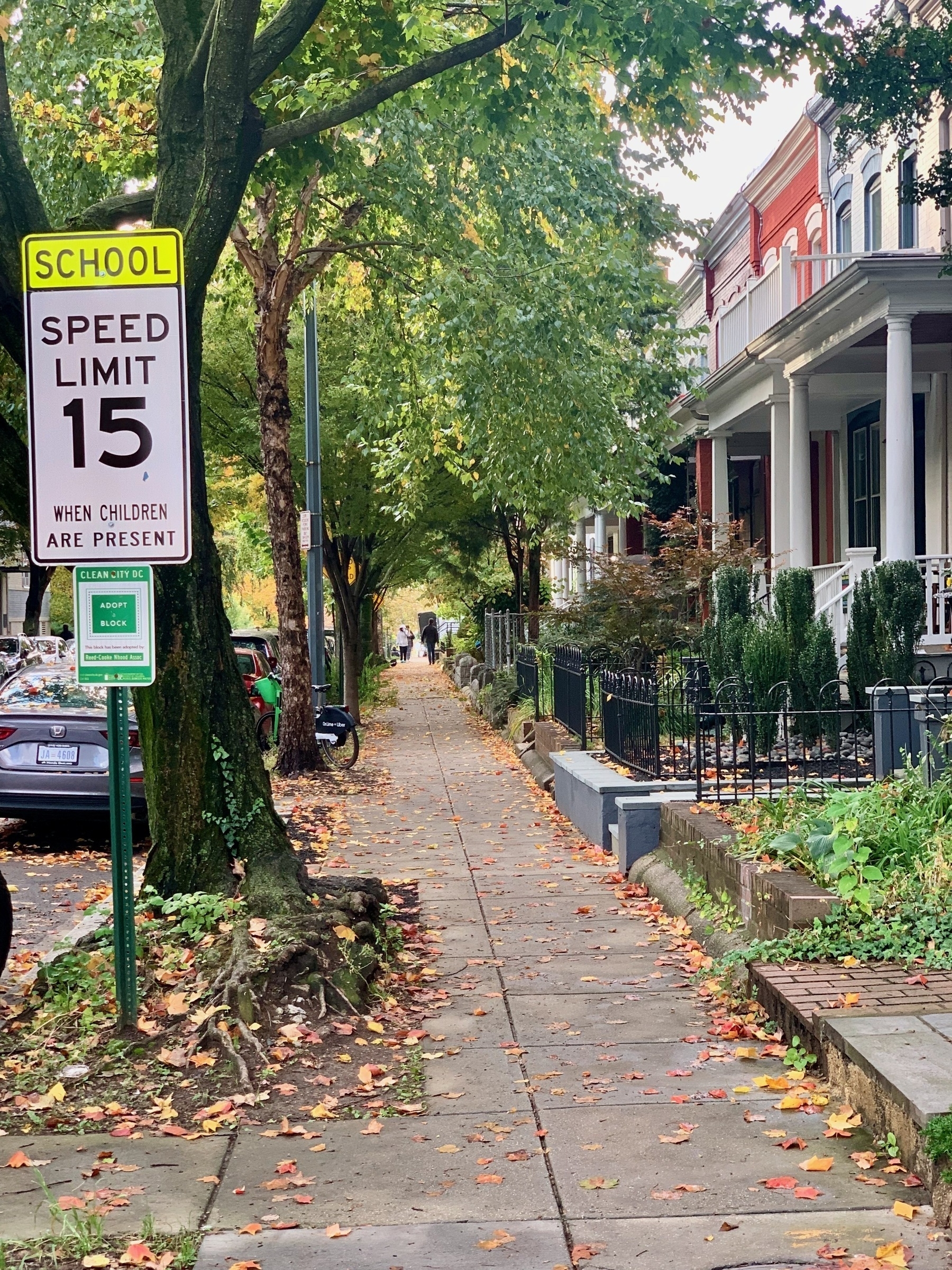
Our old neighborhood on Ontario Road, this time last year. Half of these row houses are now but a shell, ready to be converted into flimsy condos. So it goes…
Ontario Rd NW, Washington DC.
Some Friday afternoon drug price whataboutism
I had a bad reaction to a tweet an X-post
Let this be the last time I cross out the word “tweet” in reference to posts on X. I actually quite like calling them X-posts, since ex post philosophizing is the most common mode of discourse there.yesterday saying that:
…effective drugs suffer from the silent hero problem that Taleb wrote about in The Black Swan. Many can prevent far worse downstream outcomes (hospitalization, surgeries, chronic pain, early death), but we don’t tend to reward acts of prevention like we do acts of correction. Thus, surgeons are revered and drugs are reviled.
Why would I have a problem with a statement as obvious as that? Yes, humans overvalue procedures and neglect the importance of drugs, especially those with a delayed effect, no matter how large the effect may be. Well, the ellipsis hides the first part, which was agreement to a quoted post which is one of those newfangled blog posts disguised as an X-post so apologies for the long quote:
Drug industry’s [lack of] popularity is thanks to its own success. … If you have a disease for which there is a medicine, you don’t know anything other than the bill at the pharmacy counter.
If you have a disease without a cure, all your faith is put into the drug industry because no one else is coming to help and nothing else matters.
And if you don’t have a disease (yet), you really don’t care other than your fear of the bill you might one day get at the pharmacy counter.
The great irony here is that the pharmaceutical industry doesn’t control what you pay at the pharmacy counter: your insurance plan does.
Followed by a graph that shows plumetting public opinion of the pharmaceutical industry according to Gallup polling, from ~40% positive, 37% negative in 2014 (peak recent positivity) to 18% positive 60% negative in the most recent year, which I presume is 2023 but the image doesn’t say.
This is an example of a reverse-BS sandwich, where three interesting (and perhaps even true) observations are layered in between two nonsensical pieces of dreck.
Let’s start with the middle first. Per the second statement, if you have a disease, and there is a cure, the only thing you “know” is what you have to pay for it at the counter. I would argue that this is only half-true: as a patient, I would also know how I should take the drug (pill, self-injection, infusions at an infusion center, hospitalization, etc), how often and how easily (from a four-times-a-day horse-pill to an ocassional subcutaneous injection), how quickly it works, and what the side effects are. For any particular disease there may be several options, with more convenient and/or less toxic ones costing more; and people may be ready to pay more for the convenience and/or fewer potential side effects. The price difference may not even be that high, like in the case of four-times-daily versus once-daily antibiotics. So there is quite a bit of nuance there, but hey, it’s X: if there needs to be some simplification to make a valid point, that’s OK.
But then after reading the statement that follows I’m not sure if there is any point to be made. It’s an attempt at a dichotomy — separating diseases into those with and without… something. For there are many diseases for which there are medicines, but those medicines are not cures: the terms aren’t interchangeable. And for incurable diseases, the pharmaceutical industry is emphatically not the only place in which people put their faith: see complementary and alternative medicine, support groups, religion. There are many people of different persuasions, motivations, ambitions, and fee schedules who will happily give their support. But lest this is construed as nitpicking I will squint once again and let it pass, assuming that the preceding statement talked about cures, and not medicines in general.
The next statement is absolutely true. Healthy people in general have a hard time imagining what disease is like, and we all know what a financial nightmare American health care can be.
The first sentence is a strong statement of causation: that the pharmaceutical industry is unpopular thanks to — which I interpret as because of — making such good drugs. I’ll attempt to construct the three that follow into supporting arguments:
- You have a disease for which there is a cure. You take the cure for granted and you don’t like the pharmaceutical industry because you have to pay for their drug.
- You have a disease for which there is no cure. You don’t like the pharmaceutical industry because you had put all your faith in them because of their past successes (see above), and they have failed you.
- You don’t have a disease. You don’t like the pharmaceutical industry because you are scared of what may happen to your finances if and when you do get sick.
Do get in touch if I didn’t get this right, but if I did, I’m afraid it’s bad reasoning. It does point to prices as the reason for pharmaceutical industry’s unpopularity, but neglects the price of the vast majority of medicines which are not cures, yet which people take with flimsy or no evidence because of medicalization of normal variability, use of bad surrogate endpoints, and, for terminal diseases like most metastatic cancers, lack of alternatives. The industry isn’t unpopular because it charges to much for life-saving drugs (if anything, it charges too litle), but because it puts out — pushes, even — wimpy drugs that treat nothing in particular.
Yes, if it weren’t for the “silent hero” problem people may be more appreciative of the benefits and the industry may be slightly less unpopular. But make no mistake: the industry as a whole is unpopular because it overweighed the amount of slack it would get riding the coat tails of the many truly miraculous drugs it came out with in the last 20 years, from antiretroviral therapy for HIV, to hepatitis C treatments, immune checkpoint inhibitors, SARS-CoV-2 vaccines, and, most recently, semaglutide (Ozempic).
As for the final statement, well, it’s wrong in two ways: one — the wholesale price sets a ceiling that the patient would pay. Medical insurance could not make the patient pay more for a drug than the drug actually costs. Second, many pharmaceutical companies will be all too happy to cover the entirety of your co-pay for their specialty product, since it is usually significantly less than the margin they get on the agreed-upon price for their drug.
So anyway, I hope you can now see why a simple scroll down the time line is not an easy exercise for me, or really for anyone with more than a passing knowledge of the American drug price problem. There are no purely good participants on any side (even patients, which is a bit of anathema but take a look at the average American’s overflowing medicine cabinet and compare it to that of someone from Europe), and there are very few truly evil parties anywhere (although, yes, some do come to mind). So instead of rapid-fire whataboutist replies, I write articles like this to vent. I hope you don’t mind.