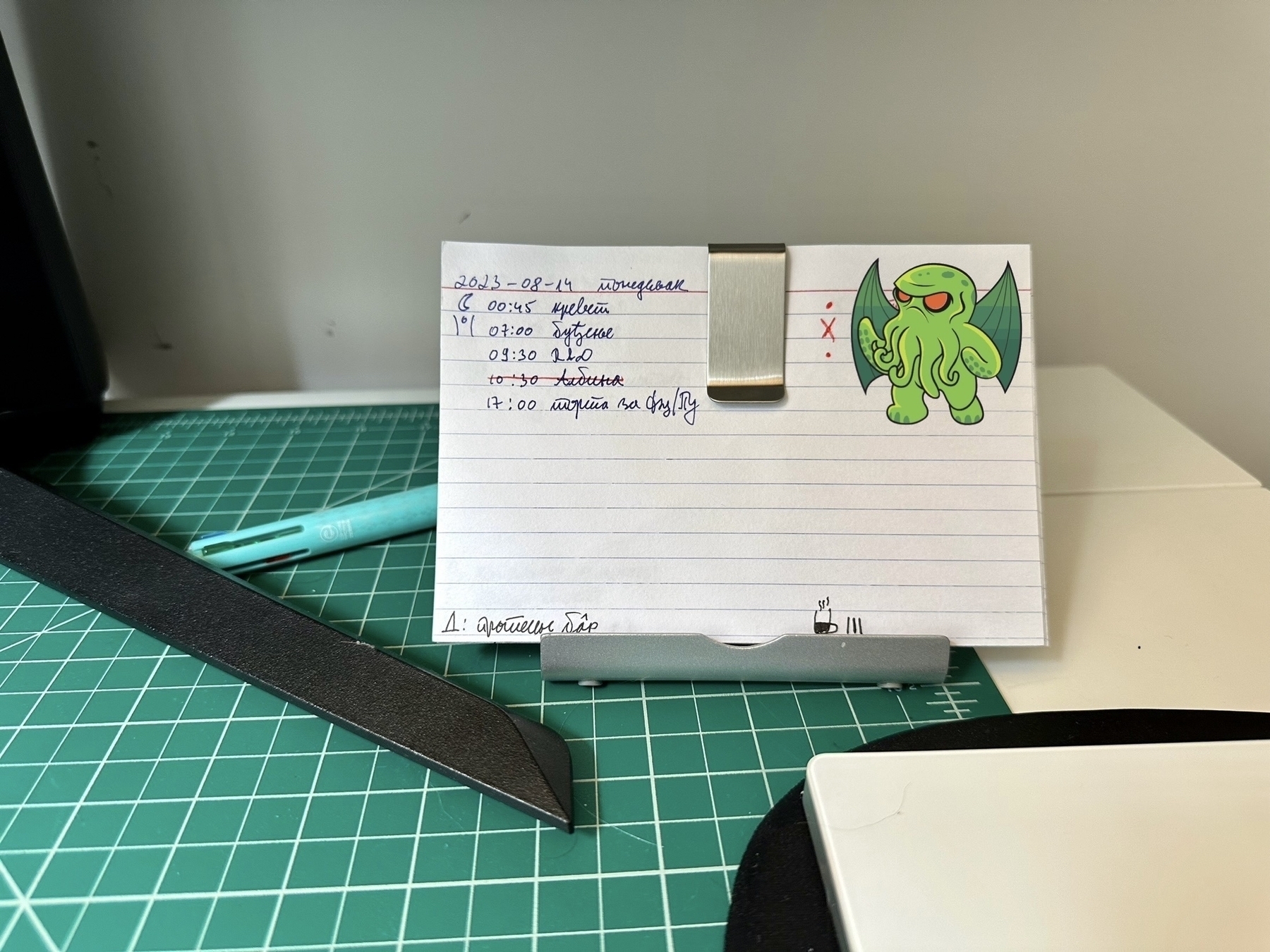
🗃️ The analogue dashboard is working better than expected! This is how it started.
My favorite podcast host, Russ Roberts, has just posted an interview with one of my favorite bloggers, Adam Mastroianni: on the Brain, the Ears, and How We Learn. This is their second conversation; the first was on Peer Review and the Academic Kitchen. Highly recommended!
I As a side note: Paperwhite is objectively worse in turning pages than the original Kindle. Poor touchscreen and unclear areas mean that I am never quite sure what will happen when I try to turn the page. Having real clickety-click buttons — not that capacitive junk — would have greatly improved the experience. tried using my Kindle more, I really did, especially for nighttime reading for which Paperwhite’s backlight seemed tailor-made. But I couldn’t. The experience felt off, and no matter how good the book was, picking up the tablet and flipping through the pages felt like a chore.
Scrolling through micro.blog’s timeline, I think I found out why:
surveys indicate that screens and e-readers interfere with two other important aspects of navigating texts: serendipity and a sense of control. People report that they enjoy flipping to a previous section of a paper book when a sentence surfaces a memory of something they read earlier, for example, or quickly scanning ahead on a whim. People also like to have as much control over a text as possible—to highlight with chemical ink, easily write notes to themselves in the margins as well as deform the paper however they choose. The Reading Brain in the Digital Age
I don’t know about “chemical ink”, but knowing where I am in the book — especially a 700+ pager Content warning: A nazi biography. — is important for how I retain information (less important) and my sanity (slightly more so).
As for reading proper (chemical?) books at night: that problem may be solved by this one simple trick, not due to arrive until Thursday. Let’s see how it goes.
I love that micro.blog hosts blogs as static websites. But if I were ever to need a non-blog static website, FastMail would be my number 1, 2, 3… host of choice. They’ve managed my email for a decade and have been nothing but outstanding. ↬This day’s portion
The Yugo had problems, but it also had the right idea: a cheap, fuel-efficient, sensibly sized car where the only point is transportation from one place to another. Cars as conspicuous consumption has been a disaster for the planet and for society at large. The end goal is to move away from car dependency and toward actually sustainable transportation — but as long as we have cars, small and fuel-efficient is the standard by which we should build them.
The Yugo as a foot soldier in the war against cars? Checks out.
🗃️ The analogue dashboard is working better than expected! This is how it started.
🍿 Murder on the Orient Express (1974) was apparently the only film adaptation that Agatha Christie liked, though she thought Albert Finney’s mustache weren’t impressive enough. It’s a good movie and a remarkable cast, but I bet she would have found David Suchet’s Hercule Poirot even better.
Our introduction to Smith Island, Maryland was the eponymous cake. The story that came with it — accessible only by boat, sparsely populated, bird sanctuary — put it on the (long) list of places we’ll see and things we’ll do once we stop dealing with diapers, where it languished until the news of the island’s impending demise reminded us that the collective we have been out of diapers for years now, and it was the summer break, and we didn’t have anything planned for the coming weekend, and unlike 10 years ago there were now AirBnB listings, and before the day was done we had a one-night stay booked in Tylerton, One thing I realized — and I really didn’t need to go to the island for that, looking at a map would have been enough — was that a more appropriate name would have been Smith Islands. You not only need a boat to get there from the mainland, but also to jump from village to village, since the island is criss-crossed with canals. the smaller and more isolated of the three island communities.
This plaque will great you in Ewell, the largest of the three communities.

And… yes, the demise is near, but not (only) because of climate change. There has been an exodus of people my age and younger from the island, which now has a population one tenth of what it was in the 1990s, comprised for the most part of people 60 and above.
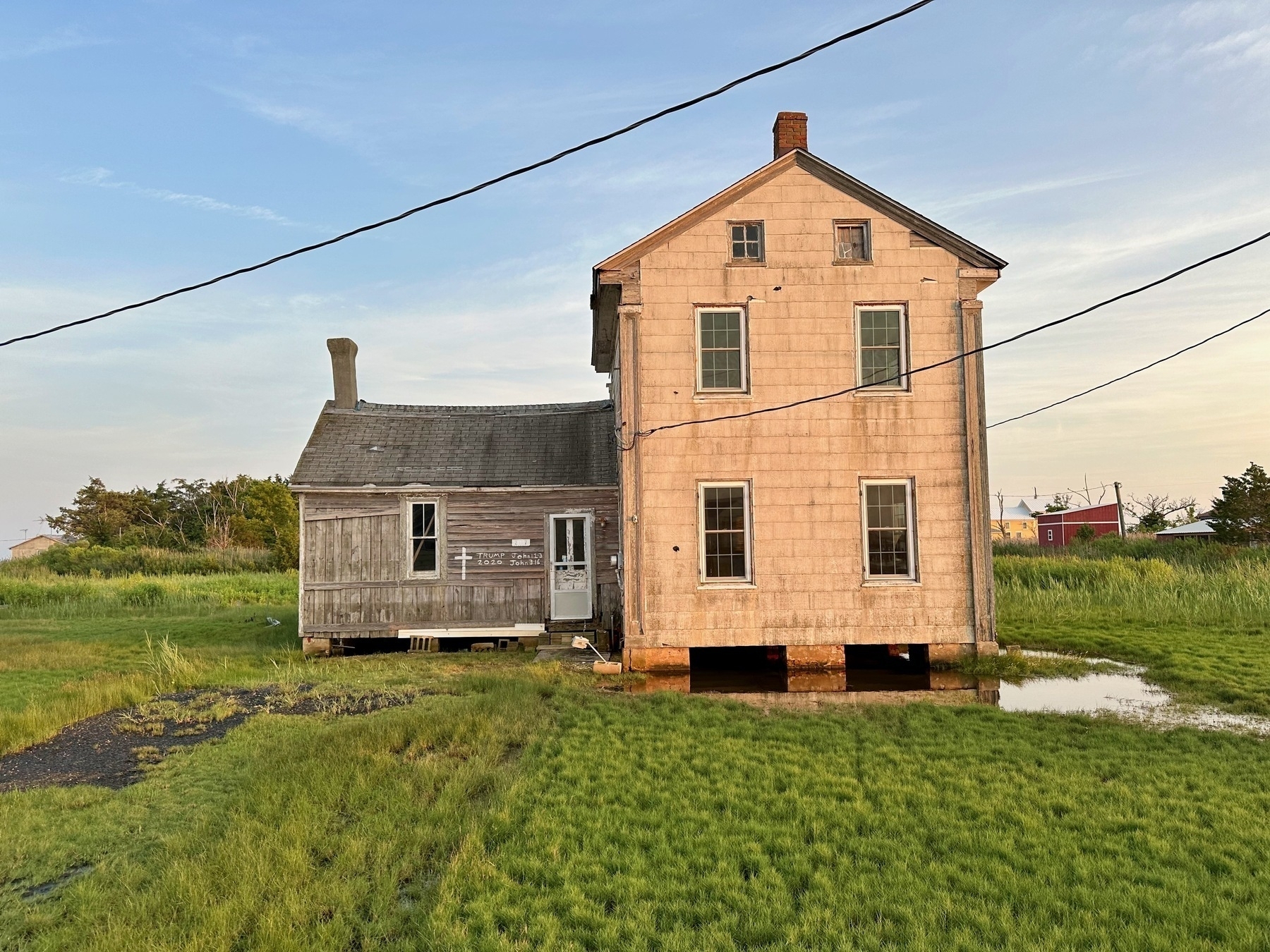 The house seems abandoned, though the political slogan on the left would suggest otherwise. Note that it would be submerged if it weren't on brick stilts.
Most of what is left is beautiful — political slogans for the 2020 elections of the kind you would expect on the Eastern Shore notwithstanding — but the crumbling, abandoned houses whose backyards have turned into swamps are impossible to miss. In a place so overwhelmed by nature humans have to work extra hard just to keep things as they were, and while Smith Islanders have been working hard, there is just fewer and fewer of them around.
Which is a shame, because the island has been continuously populated since the 17th century and if anything humanity has more technology and more resources now to continue this unique culture. Hasn’t the Netherlands successfully fought the Atlantic ocean, never mind the quiet waters of the Chesapeake? But the Dutch have nowhere else to go, whereas there is plenty of space left in North America. Smith Island wouldn’t be the first one in Maryland to be abandoned.
But while it’s there, do go and see it. Bring bug spray. Bring cash. Bring more of both than you would have thought reasonable for a short stay. Don’t plan on walking outside much, unless that bug spray you bring is really good. If you own a boat, bring that too and don’t be reliant on the once-per-day ferry. If you don’t own a boat make sure to call captain Eddie Corbin to help you around and show you the nesting brown pelicans. And get a story ready for your kids when they see a seagull kill and eat a few of the young from the nest in front of their eyes. Like, isn’t nature grand? or some such. With or without a boat, get a Smith Island cake from Ms. Mary Ada Marshall, either directly or from the only store in town, which will also have the best soft shell crab sandwich you’ve ever had, and the best crab cake outside of Baltimore’s Faidley’s.
There is more violence on this beach than the photo would suggest.
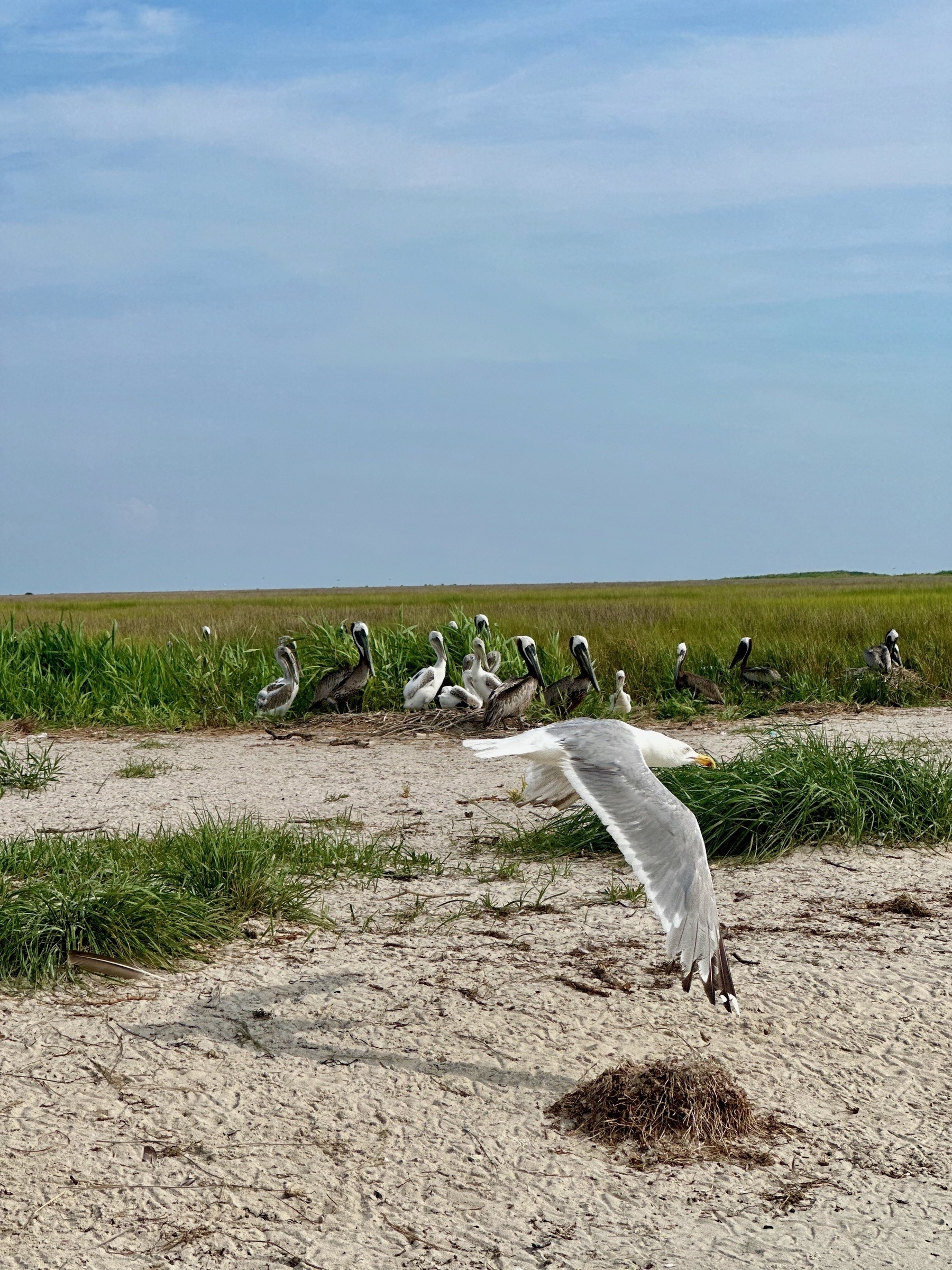
But seriously, have that bug spray with you.
The complete opposite of Smith Island: modern-day Orient Express, from Calais to Istanbul via Budapest instead of Belgrade. Five-day trip in a regular cabin starts from $25K, and it is that much per day if you choose the double-bed suite. The YouTube videos are quite something.
The Atlantic has a short (true!) story about DC politics:
“It’s almost like the government’s imposing its will on its residents,” Trayon White, the D.C. council member for Ward 8, said at the council’s June 6 legislative meeting. He wasn’t talking about a proposed highway, a subway station, a power plant, or—perish the thought—an apartment building. He was talking about trees: specifically, three linden trees on Xenia Street planted a few years ago by D.C.’s Urban Forestry Division. To my surprise, the legislative body of a major American city experiencing escalating homelessness and a serious spike in violent crime dedicated a quarter of its time that day to discussing three trees.
To be clear, he wants the linden trees removed! For context: Ward 8 has a single grocery store which may be closed due to increasing costs of security.
Three months ago I would have thought this recognize-the-scam quiz from The Washington Post was too easy, misguided, just useless. But I’ve recently seen my dad interact with the modern Web, and I strongly recommend you forward this link to anyone you know who is over 70.