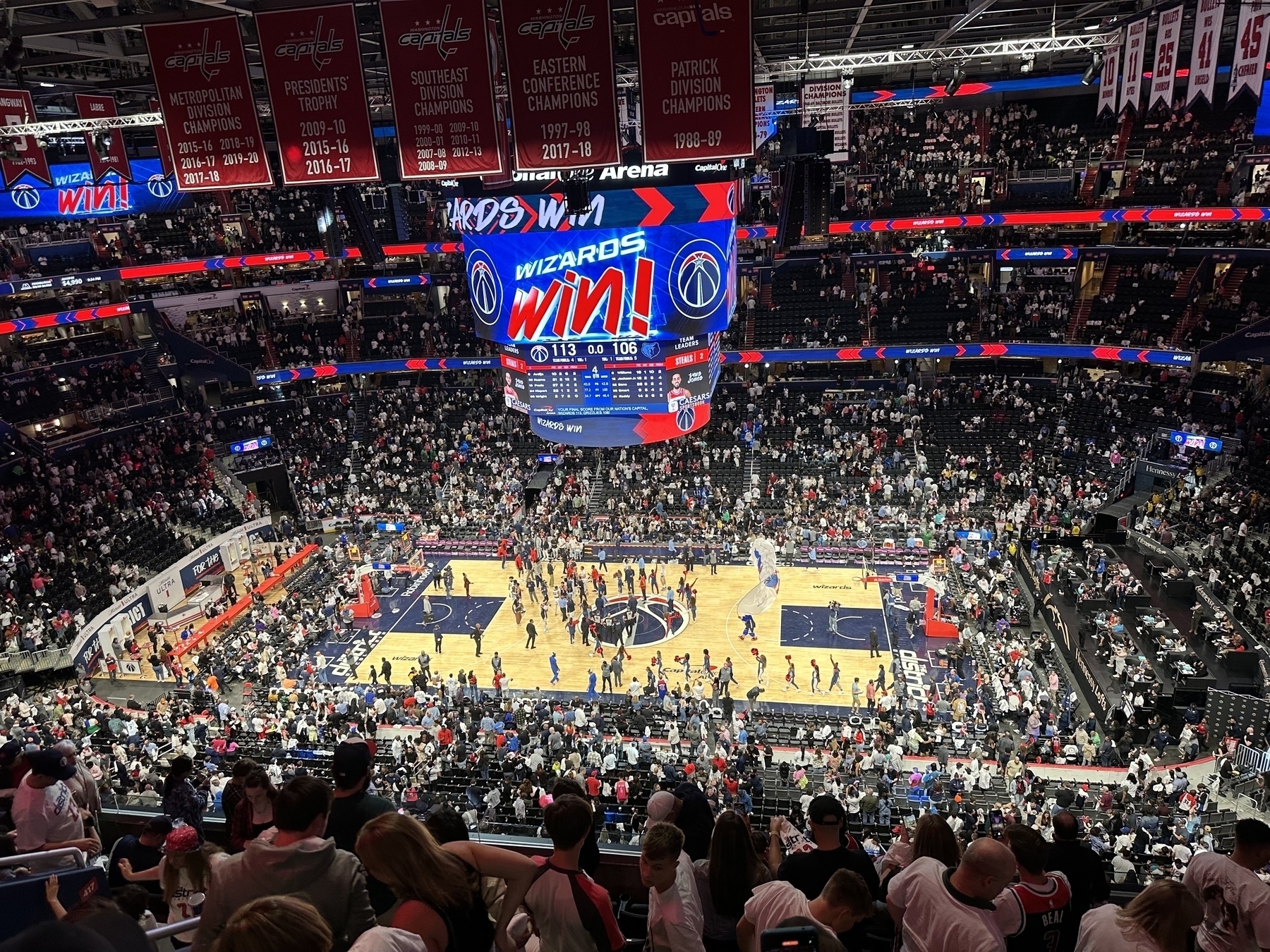
🏀 This was… better than expected! Though still horrible defense.
On this day 85 years ago, at 8pm Eastern Time, Orson Welles performed The War of the Worlds live on radio. Things escalated quickly. I will give major nerd points to Apple for even an oblique reference to the radio drama at tonight’s event, but I am not holding my breath.
One of the most level-headed descriptions of the “current situation” comes from the former French prime minister Dominique de Villepin in an interview with Appolline de Malherbe. His answer to the question of whose fault it was:
But Ms. Malherbe, I am trained as a diplomat. The question of fault will be addressed by historians and philosophers.
Unsurprisingly, he never held elected office. That kind of nuanced thinking will never get you enough votes.
In Washington DC Subway Memory Game you have to guess the names of as many DC Metro stations as you can. There are no extra points for guessing the location, though I would happily pay for that in-app purchase. After seven years of staring at those ceilings while commuting to Bethesda one would think I would be most familiar with the red line, and one would be correct — I had 23 of 27. My worst was the orange: 7 of 26, and two of those were overlaps with other lines.
If you liked the previously mentioned Secrets of… videos and station layout maps, this one is well worth checking out. (↬r/washingtondc, whose users of course had some rather uncharitable comments about bugginess of a free game made by an enthusiast. Never change, DC!)
Chris Arnade walked through Japan again, and his notes are as good as ever.
In both cases, the working and middle class Japanese and English are forced by a lack of options, to develop their own sense of self. Which includes lots of hobbies.
They are not inflicted with the US-style careerism, where you’re never supposed to be satisfied with what you have. Where the belief that you can, with the right amount of dedication, move up into ever and ever higher classes, presumably with the intent to reach a materialistic nirvana. Which I guess is a five-bedroom home, with a four-car garage, and a big lawn. A big lawn you pay someone else to take care of, because who has the time for gardening?
That’s why I came back to Japan, and that’s why I walked England twice, and why I will keep coming back to both.
And I’ll keep coming back to Chris’s newsletter!
The Benefits of Being a Young Mom:
My mom, who had me at 22, worked as a nanny for other people’s children when I was a baby, bringing me to work with her in St. Louis, where we were living so my dad could finish school. She had a few rules for kid-raising: no need to go to the doctor for most things (better to wait and see if a malady resolves on its own); a cardboard box from the garage makes for the most thrilling play; and babies can—and should—be brought practically anywhere.
I’m not a young mom, but I can vouch for the soundness of these rules. We did have our first child at an awfully young age for the East Coast (28–29!?)
🏀 The best pass in NBA history happened so fast that the camera, the commentators, and most of the audience completely missed it.
🏀 This was… better than expected! Though still horrible defense.
☕️ My preferred coffee making method has been freshly ground pour-over for a while now, but whenever we are out of whole beans (like we were this week), Mehmet Effendi is the standby. Taleb called it East Med coffee but of course it’s known as Turkish in most other places. Considering that it probably came from Yemen and spread around by the Ottoman Empire, Ottoman coffee may be the most precise name, but of course everyone will call it however they like (Bosnian coffee? Really?)
I read with great interest Sam Altman’s essay *How to Be Successful. [Note: Five years after it came out! Better late than never. ] It presented many interesting nuggets of wisdom, such as:
You get truly rich by owning things that increase rapidly in value.
…
The best way to make things that increase rapidly in value is by making things people want at scale.
So, can someone please explain to me, like I am a nine-yer-old, how did Sam Altman become successful? It couldn’t possibly have been Loopt, a little-known geo-social service. Well, the very last sentence in the essay, added as a response to Hacker News comments, gave it away:
I am deeply aware of the fact that I personally would not be where I am if I weren’t born incredibly lucky.
He should have started with that! Silicon Valley people apparently like talking about “first principles”, and it seems clear to me that the first principle of being wildly successful (or “truly rich”, which Altman tellingly equates) is to be lucky; everything else is ex post narration. I want to read an essay that starts with luck: how to recognize it, how to expose yourself to it, how to benefit from it. This will inevitably become an essay about probability, so Nassim Taleb would be the perfect person to write it, and indeed he did! Only the topic is much too complex for a short essay so yes, it’s a book, and to fully appreciate it you may as well read the whole of Incerto.
And if I am contrasting Taleb with Altman — which may be an unfair comparisson to Altman as there is a bit of an age differential — here is what Sam says about hard work:
I think people who pretend you can be super successful professionally without working most of the time (for some period of your life) are doing a disservice. In fact, work stamina seems to be one of the biggest predictors of long-term success.
The parenthetical is doing a lot of work here, and the thing left unsaid is that with this ethos you can end up working really hard your whole life and end up safe from poverty, but not wildly successful… like most Americans! Here is prof. Taleb:
Solid financial success is largely the result of skills, hard work, and wisdom. But wild success (in the far tail) is more likely to be the result of reckless betting, extreme luck, & the opposite of wisdom: folly.
Indeed.
P.S. While the essay reads better than the recent Techno-optimist hocum (a low bar), did he really need 17 people to review his drafts, including… Diane von Fürstenberg? Seriously?
I’ve just spent 45 minutes teaching a dozen and a half first-graders how to use a microscope — with mixed success — and it was the best time I’ve had all week. We looked at frog’s blood, the leg of a housefly, paramecia, and some pollen, all of which sound like something a witch would have on hand. Perfect for Halloween!