🍿 Guillermo del Toro’s Pinocchio: beautiful stop-motion animation with inexplicable changes to the original. What is it with del Toro and fascism? Still, it has easily become our household’s cannonical version of the story.
I tend to avoid Joe Rogan and knockoffs, and even get slightly upset when people tell me how “he made podcasting happen” (ditto with Serial, to a lesser extent).
Last year, I set out to read at least 22 books, and gave my self a list. Things went better than planned: in addition to 19 of the 22 books from the list, I found time
I attribute this to one thing and one thing only: waking up one hour before anyone else in the house. After all, who needs sleep? for 13 more.
In no particular order:
The Scout Mindset (Julia Galef)
The links mostly go to my reviews, as brief as they may be. If I haven’t written about some of these — and I am only now finding out I have skipped quite a few — the link is to the book’s Amazon page. So it goes…
Light (M. John Harrison), which I haven’t written about, maybe because it was a re-read of a book that fascinated me way back when I was in medical school, or maybe because Harrison’s dense prose made me so numb I couldn’t write anything for days. Regardless, it is a masterpiece of science fiction.
Making Things Work: Solving Complex Problems in a Complex World (Yaneer Bar-Yam), which is another one without a quick review, though again I can’t remember why. Bar-Yam is now more known for his zero Covid activism, which is unfortunate because it may turn away people from his general work on complex systems and the importance of scale.
The Morning Star (Karl Ove Knausgaard), but I know full well why I didn’t write about it — it was because I didn’t like it and, even worse, I recommended it to a friend before reading the whole thing on the strength of the setup. Turns out setup is all it was. Shame.
Checkmate in Berlin (Giles Milton) which I ended up liking more than the unfocused Checkpoint Charlie, though what the message is other than be careful of temporary solutions because they may last longer than you think, or want I am not quite sure.
Scientific Freedom: The Elixir of Civilization (Donald W. Braben) is another one that didn’t sit with me as well as I thought it would, mainly because it turned into the author’s explanation and justification for what the research institue he was running did. Old man explains himself can be a good genre — see Pieces of the Action, above — but this one didn’t quite cut it.
Gödel, Escher, Bach (Douglas R. Hofstadter) was the best book I read this year. I didn’t write about it because I wanted to keep it for myself but I guess that now the secret is out.
Building a Second Brain (Tiago Forte) had the opposite effect of the intended: I realized that the PKM genre is mostly BS and that people with the best “systems” — if you can call them that — don’t write about their workflows but rather about the things around and because of which those workflows were created in the first place. Ryan Holiday comes to mind, but really it is better to find the people in your field whose work you admire and see what they are doing, not what some PKM guru is saying you should do.
The Courage to Be (Paul Tillich) which left enough of an impression that I dedicated a whole podcast episode about it, though in Serbian. What I really thought about non-Serbian speakers shall never know.
Coddling of the American Mind (Greg Lukianoff and Jonatha Haidt) was merele OK, as it considered the general decay of intellectual life as phenomenon isolated to American universities. Haidt, one of the authors, recently wrote a brilliant essay correcting this mistake.
Mere Christianity (C.S. Lewis), which I didn’t understand. I should probably read it again and with more care. A project for another year…
Dishonorable mention goes to Ministry for the Future, the only book I started this year without finishing because it read as an underbaked piece of propaganda. The only other book in recent memory which suffered the same fate was the loud, the insufferable, the too smart for its own good Catch 22, to give you an idea of my literary proclivities. They just weren’t for me.
Re-reading each time I change how I make coffee: from AeroPress (early 2010s) to a Moka pot (late 2010s) to an ECM Synchronika espresso machine (yes, a pandemic purchase) to, currently, manual pour-over with Ratio 8.
🍿 A Trip to Infinity started off strong: I can never get enough Steve Strogatz, and between him, Eugenia Cheng, and Moon Duchin the first third of the documentary focusing on mathematics was stellar. Then came the muddled physics and incomprehensible philosophy. Too bad.
December 29, 2022
🍿 Top Gun: Maverick was, no doubt, the best comedy of the year. By the end I felt like standing up and chanting U–S–A, and I was bombed by those photogenic sociopaths not so long ago. The magic of cinema…
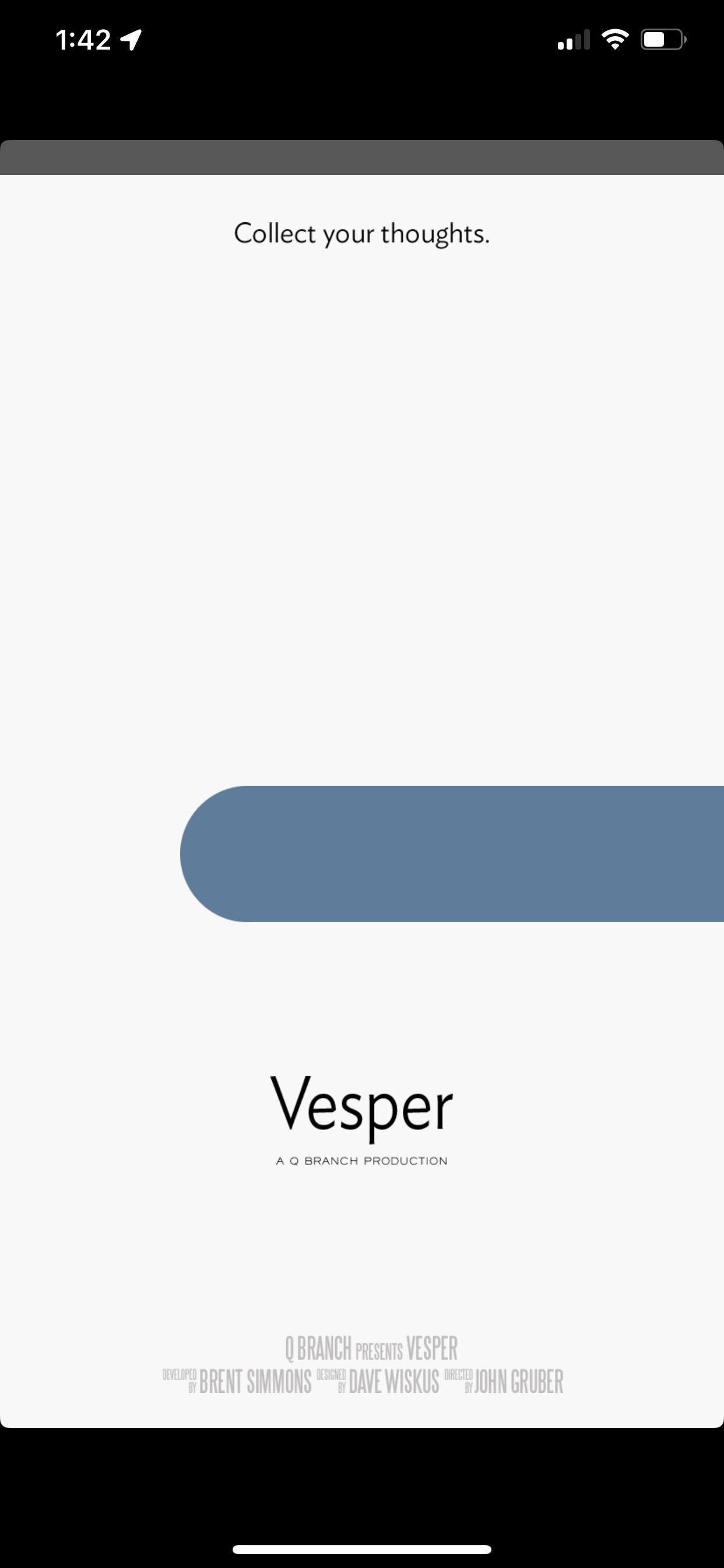
We are only 6 months away from the 10-year (!?) anniversary of Vesper, an app that not only still works on iOS 16, but feels more at home there than on the iOS 6 it was made for. Kudos to @brentsimmons, Dave Wiskus and @gruber for seeing the future. Too bad iOS 7 overshot.
Fractional use of vials/pills to decrease per-patient cost, because the main driver of high cost of drugs is not manufacturing (i.e. a ten times more efficient manufacturing process would not result in 10 times, or even 2 times lower prices). If you don’t believe me just look at what Sanofi did with alemtuzumab.
Using real-world data instead of randomized controlled trials, because while retrospective, non-randomized, uncontrolled studies
Now rebranded as “real-world data”. are good for generating hypotheses and maybe, maybe, detecting enormous effect sizes
Think: smoking causing cancer, but not: who-knows-what new material causing lymphoma. we have learned through much trial and error that RCTs are critical for evaluating whether a medical intervention works or not. Back when personal computers were too big and expensive for mass use, the answer wasn’t to invent a story of why calculators were better — it was to make PCs so cheap and small that not having one in your pocket was a matter of personal choice, not cost. Same for RCTs.
The Choosing Wisely initiative, which was all the rage back when I was a resident and still seems to have legs.
Not to mention that the program unintentionally promoted a dangerous frame of mind in which some doctors thought extensive testing was never indicated, thus missing some rare but life-theratening diagnoses. Money spent on producing more content for doctors to read, listen, and watch — thus taking up their time — and encouraging patients to talk to their doctors at length about questionable data behind many of the procedures — thus, again, taking up their time — may have been better spent designing and running pragmatic RCTs that would answer these questions and save both the doctors' and patients' time by reducing ambiguity. Oh well.
Yet another health care delivery reform — this may be just my healthcare policy naiveté, but these all had the whiff of rearranging deck chairs on the Titanic.
See also: the Homer Simpson car Mandating the desired outcome instead of thinking about the right incentives is bound to increase cost through second-order effects.
Link rot (also called link death, link breaking, or reference rot) is the phenomenon of hyperlinks tending over time to cease to point to their originally targeted file, web page, or server due to that resource being relocated to a new address or becoming permanently unavailable.
Sifting through dozens of old blog posts as I transfer them to Micro.blog, a few things are becoming evident. Having a newborn in the household is not conducive to writing. The period from Thanksgiving to New Year’s Day is. And most of the internet I have linked to in the past no longer exists.
Take this short, 8-year-old text about vim. It mentions one podcast and two blogs; none are still around at their original location. The podcast was Technical Difficulties which, if memory serves, was a podcast of Gabe Weatherhead and Erik Hess that ran for 2 years from 2013–2014 before disappearing into oblivion. One of the two blogs was Dr. Bunsen by Seth Brown: also gone, but at least available through the Wayback Machine. The second was from Steve Losh whose website is either down or having temporary difficulties, but in any case unavailable on Wayback.
So this little expedition through just three links took me a good 15 minutes; updating all of the old posts with new links and explanations like this one would not be the best use of anyone’s time. But what are the alternatives?
Gwern Branwen’s website comes to mind, as he goes as far as hosting complete pages on his own server while using icons to point to the original URLs. The afformentioned Wayback Machine also hosts web page snapshots. Would a script converting original URLs to their archived counterpart be hard to find, if not make?
Those are not bad ideas — for a digital garden-type project. For an effemeral blog such as this one, the effort-to-benefit ratio leans the way of my learning to live with link rot. So it goes.
This rump week would be a better time than most to work on the pipes here, if not for my having to do actual work.
Which is all good! There are some exciting news coming in early 2023 which yes, need my absolute attention even on a holiday.Still, I will dedicate a few hours transferring posts from the ole' pelican-poweredInfinite Regress — around since 2014 as a self-hosted blog and since 2012(!?) on SquareSpace — to using micro.blog full time.
It was an easy choice, driven by two factors: the Tufte theme for micro.blog is just that good of a look — thank you, @pimoore! — and posting from MarsEditVia BBEdit for titled posts, such as this one. on an M1 Mac is just that good of a workflow.
Also fairly expensive — the 2014 me would have balked at a $5–10/month subscription and two pieces of $50+ software — but at a certain point time becomes more valuable than money and if you haven’t already reached that point I hope that you soon do.
So, I will be happy with just a transfer of old posts, plus-minus switching up footnotes to marginnotes and sidenotes as needed. Time permitting, I will make a few tweaks to the page layout, colors and font, but these will be gravy. The Infinite Regress layout has lasted more than 8 years, and I can easily see this one lasting 8 more.
Speaking of IR, converting it to a digital garden-like website
The link is to Maggie Appleton’s overview of the history of digital gardens, and if you haven’t been to her website before, you are in for a treat. is the next big project, one that will have to wait for the next infrastructure week.