I love my current blog template: good typography, pleasant color scheme, Tufte-esque footnotes. Thank you, @pimoore!
But: what knobs should I tweedle to have front page excerpts not show up like this?
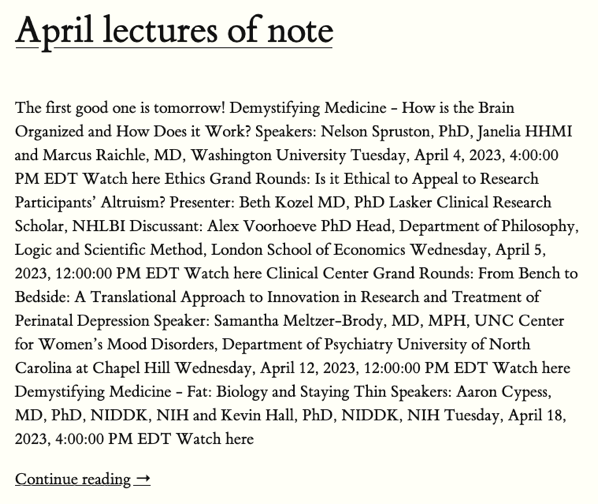
It is unseemly.
The obsession of prolific Mastodon posters with Twitter is what gets me the most. It's like professors complaining to everyone at a lecture that no one comes to lectures any more. Wrong audience?
📺 Severance… Well, what is there to be said about Severance? Just hook it to my veins.
The first good one is tomorrow!
I love my current blog template: good typography, pleasant color scheme, Tufte-esque footnotes. Thank you, @pimoore!
But: what knobs should I tweedle to have front page excerpts not show up like this?
It is unseemly.
At Numeric Citizen’s recommendation I downloaded the Ulysses app for iPadOS, as it has built-in micro.blog integration. Lo and behold, I had already used Ulysses for posting to my old Pelican blog, back in 2016. I know this because it still had unpublished drafts, forgotten and abandoned in its iCloud sync folder. Here is one from February 8, 2016, title as above:
This is why post-2010 Internet is dangerous. Buzzfeed, 9gag, etc. are in an arms race for clicks via overproduction of worthless garbage that gives you illusion of knowledge and/or understanding. The battlefields are Facebook, Twitter, and your mind. Only one of those is likely to survive without significant collateral damage.
The sentiment still stands.
Beside the point but interesting nevertheless is that I would easily have published it as is — well, let’s pretend that last sentence turned out better — had micro.blog existed back then. But when posting to a blog is this whole production: is the header OK; is the markdown file in the right folder; make the blog; commit to git; push; oh no, there’s a bunch of typos; why is it throwing these error messages… when there is that much overhead, you are kind of incentivised to write the kind of long treatises I backhandedly mentioned yesterday. So that meger paragraph above obviously wasn’t enough for me to cross the activation energy treshold for publishing.
Which is too bad: I could have planted a flag for digital minimalism years before Cal Newport.
Let’s put Artificial Intelligence (in the broadest sense, from Siri to algorithms deciding what you see in your Facebook/Twitter/Mastodon timeline to DALL-E and GPT) in context of the humankind’s biggest ever breakthrough.
There is a saying in most languages about fire being a good servant but a bad master. You can imagine — as Tyler Cowen did last week — some of our ancestors screaming against the use of fire (“Fire? You can’t do that! Everything will burn! You can kill people with fire! All of them! What if someone yells “fire” in a crowded theater!?” — to use his own words). And yet we do use it, every day, almost every hour, in circumstances so controlled and with so many contingencies, from sprinklers and fire alarms to fire departments and hydrants, that we rarely stop to think about it any more. Even with all that, many people die in home fires every day: in the US alone there were 731 home fire fatalities in 2023, and the year has only just started!
Obviously, AI as it exists now is neither as useful nor as dangerous as fire, but it is also not nearly as visible so it is easy to overlook the circumstances when it is a bad master, or opportunities for it to be a good servant.
Or rather, few people explicitly think of Youtube recommendations and Twitter timelines as “AI”, but they are, as much if not more so than Alexa or Siri, the epitomes of artificial intelligence just a few years ago. And to be clear, I consider these kinds of algorithmic, unasked-for, and un-opt-out-able recommendations as unequivocally bad! Of course, that is not absolutely always the case — there are many brilliant but otherwise obscure videos that YouTube may recommend based on your usage — but the tradeoff is not worth it as it will a) also recommend a lot of dreck, and b) put you in a mindset that these kinds of opaque algorithmic recommendations are generally good and useful (never mind that it’s the same kind of goodness and usefulness as having a fire pit in your kitchen: even if you can live with the risk of your house burning to the ground, you are stuck with cleaning soot every day, and yes also getting lung cancer, no biggie).
So, if I haven’t asked for it, and I don’t know how it works, it is out.
Note that this heuristic does not exclude Large Language Models (ChatGPT, Bard) or image generators (DALL-E, Midjourney, Stable Diffusion). These are in fact unquestionably in the good servant category, for the person who is using them. If that person has bad intent and wants to confuse, obfuscate, misinform, or, lets call it what it is, bullshit, well that’s a property of the human user, not the tool. There may be a transition point when these too become bad masters: imagine Apple sucking up all the data from your phone to feed your own personal assistant powered by their Neural Engine without asking your permission, but we are not there yet. User beware, as always.
In that context, the call for a 6-month moratorium on AI research looks particularly ridiculous. Never mind that the always-wrong peddler of platitudes Yuval Noah Harari was one of the signatories — and if he supports something you can make sure to count me in the opposite camp — it was Elon Musk who led all the news headlines, the very same Elon Musk who is a heavy user, and now owner, of one of the biggest bad-master AIs out there, the very same owner who cut off unadulterated access to the Twitter timeline and pushed their AI on everyone without consent. Well, there’s some dark humor for you.
Thankfully there will be no such moratorium, and people on the edges of tech discovery — Dave Winer comes to mind first, but I am sure there are more who are even better versed and more exposed — can try things out, test limits, make mistakes, create contingencies, so that the unwashed masses, yours truly included, can maybe one day have chatbot-like access to their personal libraries, past emails, research documents and the like. I am the sort of person who gets very excited by those possibilities, and they are just the tip of the iceberg.
So yes, if you are professional BS-er like Yuval Harari, I can see how decreasing effort to produce content that is on par with your best writings can be frightful. But for the rest, Nassim Taleb tweeted it best:
Let me be blunt. Those who are afraid of AI feel deep down that they are impostors & have no edge. If you have a 1) clear mind, 2) a deep, not just cosmetic, undertanding of your specialty, 3) and/or are original enough to reinvent yourself when needed, AI will be your friend.
Amen.
I’ve been on something of an RSS subscription spree. In addition to all the great micro.blog blogs (and many, many, many more…) there are a quite a few “old” blogs that I (re)discovered — my blogroll will need a serious update!
Notably absent from the new subscriptions are substack newsletters. It is unnerving to scroll down a website for the first time only to be interrupted by a request to subscribe, and a big draw of RSS, at least for me, is its unobtrusivness. It is there if you want it, but not in your face. The thought of following a blog regularly is of your own making, which is as it should be.
So to the bland design and the lack of control over your own content I would add this, much greater limitation of substack: choosing it to publish your writing — even if all your articles are free and unlocked, and you are honest-to-god only doing it because of ease of use — even with all that, choosing substack sends a strong signal that in the back of your mind there lies an idea that at some future point — maybe when you “have an audience”, maybe when you have “created your own platform” — at some unscpecified you’ll-know-it-when-you-get-there point you will click that big Monetize! button and you will ask people for money in exchange for your writing.
Not that there is anything wrong with that! In general. For other people. But not for me.
There is a chicken and egg problem here: I am after all a happy subscriber of Stratechery, I pay to read the Financial Times and The Atlantic, and I even subscribe to a substack newsletter or two. What is so bad about a previously free substack accepting payments? How is that any different?
The difference in how I feel about the two, I suspect, lies in substack making it too easy to monetize. There is a large group of people who are “natural bloggers”, and a much smaller subset of these who also have the mental fortitude to deal with the completely different dynamics of independent writing as a profession: consistently producing content and catering to your readers’ demands — your are, after all, working for them — without falling prey to audience capture.
So, someone who could have been hapily microblogging for decades to come undergoes premature monetization, and all of a sudden performance anxiety sets in, their ideas dry up, their writing becomes sparse, and months pass before the next gargantuan article is published which fewer and fewer people will read. I won’t name names or link links, but it has happened before and will happen even more now that many are transitioning from Twitter. And on my end — knowing that this is a possibility with every completely-free-as-in-beer substack newsletter I am following — well, I don’t get too attached. I read less attentively. I always have doubts about why that particular topic came out (preparing the future paying audience, perhaps).
Friends don’t let friends write on substack.
Subscribing to the Financial Times continues to pay off splendidly: just look at this Twitter thread from their chief statistician on the plummeting life expectancy in America. His (paywalled) column is even better.
Oh and it’s guns, drugs, and cars, in case you were wondering.
WaPo is on a roll of good opinion articles. Today’s had advice on coping with the many crises we are told we are facing:
One cannot usefully address a threat to birds if they do not delight in individual birds. (Maybe not all of them, but some.) One cannot meaningfully answer the climate crisis if they lack excitement about the human capacity for invention and reinvention. One cannot make progress toward equality and inclusion if they don’t see and love the potential of humankind — enemies included — and one cannot build the future if one fears the future.
Indeed.
A colleague once told me you were never really finished with a manuscript until you well and trully hated it — only then should you submit.
He was right, with a caveat: if you hated it at submission, however will you feel when it comes time for the umpteenth revision?