🍿Strange World had some interesting ideas, but the message got in the way of a good movie. And I don’t mean Disney’s first openly gay character (even there, The Mitchells… did it better), but its notion that destroying rather than improving technology will save the planet. Nope.
Merry Christmas to all who celebrate!
December 24, 2022
🍿Glass Onion: more Triangle of Sadness than Knives Out — the latter being a better movie — but still enjoyable. Kate Hudson and Janelle Monáe were excquisite.
One can hope that the third in the series, if there ever is one, focuses more on the murder mystery than on eating the rich.
Not much time for TV this year — which is a good thing! — but here is what we
[Note:
Yes, “we”. Watching TV is for me a communal thing and the last time I watched any show by myself was finishing up Veep in mid-2014 during my last few night shifts as a fellow.
] watched, in no particular order:
Only Murders in the Building (Hulu), which I didn’t write about but Season 2 was even better than the first and I have every reason to believe Season 3 will be even better. There is nothing with Steve Martin and Martin Short in it that I haven’t loved, and Selena Gomez was a wonderful surprise, Only Murders… being the only live action thing of hers I saw.
The Afterparty (Apple TV+), which between the murder mystery plot, the cast, the jokes, and the production values should really take the number one spot as my favorite show of the year overall.
Star Trek: Lower Decks (Paramount+), which is, let’s all agree, the best Star Trek show since the original series.
Star Trek: Strange New Worlds (Paramount+), which is the second best Star Trek since TOS.
The Great British Baking Show (Netflix), which continues being the perennial favorite, despite the humor, the baking, and the charm all slipping away year by year ever since the pandemic.
And yes, looking back at the list I have to wonder what it would have looked like if we did have time for TV. Geez.
I’ve been listing podcasts since 2014 and 5 years ago to the day it became a yearly ritual. Here is to another year of quality podcasts.
The Joy of Why by the mathematician Steven Strogatz is the best science podcast from the best science website, Quanta Magazine. He doesn’t pander to the listener and focuses more on the practicality of science than the gee-whiz isn’t science so gosh darn great ethos that plagues other popular science podcasts. The downside is that it is sometimes just at the edge of my understanding
[Note:
Or, if the talk is about mathematics, way way off.
] but is that really such a bad thing?
The Jim Rutt Show is a strange beast. The topics are more about the philosophy of science than science itself — with rare but brilliant exceptions — and Jim has a no-nonsense, tells it like it is personality that I find endearing but some might say is a bit grating. He also has unusual ideas about the future of humanity — “Game B” is the preferred name — which I am yet to digest, but that only comes up rarely.
FT Weekend by Lilah Raptopoulos is probably the heart of “Game A”: nominally it is for and about the ultra-rich readers of the Financial Times — think the abominable passengers of the yacht in Triangle of Sadness — catering to their tastes and interests, but really it is there to satisfy the podcast-listening upper middle class’s interest in that world. Funnily enough, I watched Triangle of Sadness based on Lilah’s interview with the director.
Conversations with Tyler by Tyler Cowen haven’t made an appearance in a while, but I continue listening and this year has been one of the better ones. His interview with Jeremy Grantham, the investor turned philanthropist, is hands down the best one hour I’ve spent listening in 2022.
Speaking of Quanta Magazine, their own series of year-in-review articles is out. If you have no other plans this weekend (heh), you may learn what was new in 2022 in:
Apple Music has started making year-in-review playlists and, well, 2022 was the year my kids officially took over the account. Behold the Top 10 in the Miljković household:
Enemy (Imagine Dragons): 228 plays
Quietly Yours (Birdy): 145 plays
Natural (Imagine Dragons): 120 plays
Spring Waltz a.k.a. Mariage d’Amour (Toms Mucenieks): 87 plays
We Are Monster Trucks (Kids Channel): 86 plays
Surface Pressure (Jessica Darrow): 81 plays
We Don’t Talk About Bruno (Carolina Gaitán et al.): 71 plays
Wait For It (Leslie Odom Jr. et al.): 70 plays
Le Carnaval des Animaux: Aquarium (Charles Dutoit et al): 66 plays
Radioactive (Imagine Dragons): 50 plays
Figuring out who in the family was listening to what is left as an exercise for the reader.
December 21, 2022
Dave Winer writes about textcasting, which sounds amazing. Meanwhile, sites like Serious Eats which used to be full on blogs — and sometimes still call themselves that — don’t have an RSS feed.
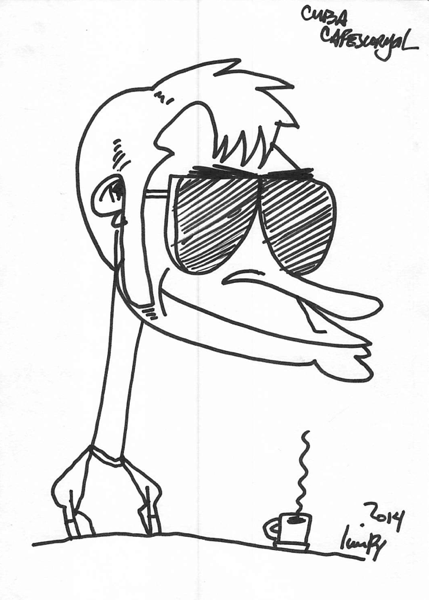
Let this unsolicited 2014 cartoon of me sipping coffee in Havana sit here for posterity as I replace it with an actual photo for my micro.blog avatar.
[Note:
Slash account photo slash profile pic. I can’t keep up with the nomenclature.
] Other than the hunched back, the often unkempt sideburns, and the cup of coffee that is always close by, it never truly was a good likeness, even for 2014.
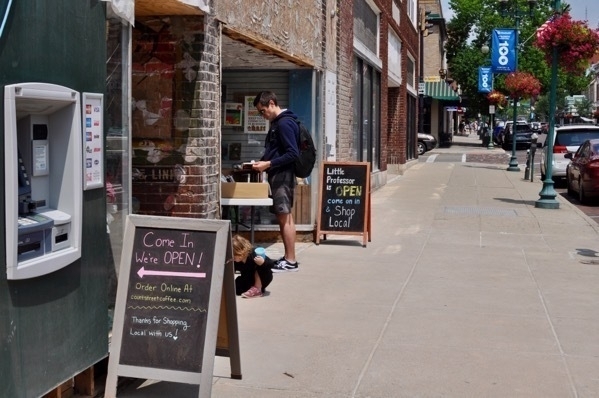
The new photo is a cutout of this particular moment in time, as I browsed through used books in front of an Athens, OH bookstore during one of our first post-pandemic trips. Yes, that feral child doing God knows what on the sidewalk is ours, and obscured by the sign just enough to be included without a privacy blur.
Athens itself
[Note:
And yes, having a photo from an institution unironically named the Athens Lunatic Asylum serve as my Twitter profile backdrop was a joke that up until now only I uderstood, but we are both in on it now, aren’t we, dear reader?
] was a delightful surprise, from the walkable downtown to its partially-abandoded Lunatic Asylum. The latter was the source of my Twitter cover photo, also saved here for posterity pending the site’s likely demise.