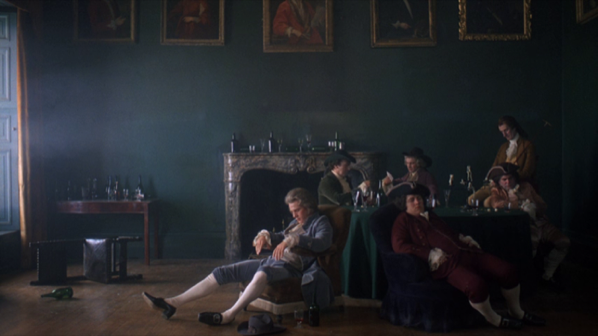
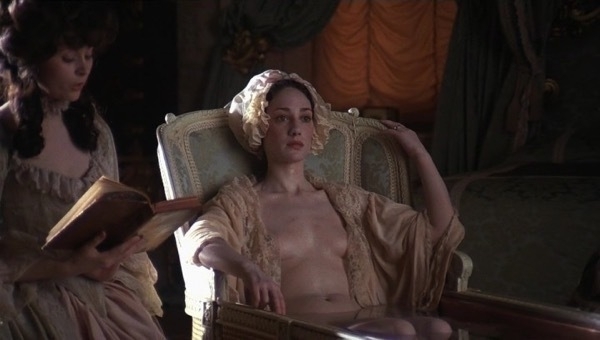
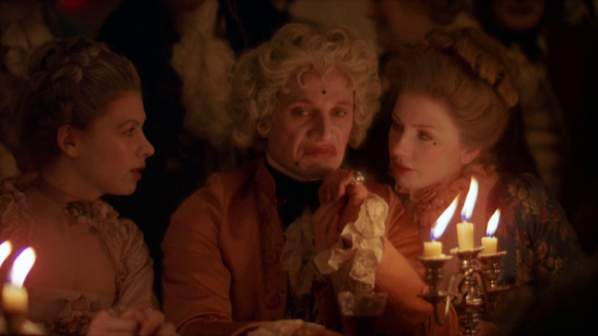
The camerawork alone makes it a timeless classic. It doesn’t hurt that the deliberate, slow pace is perfect for my increasingly middle-aged mind. Yes it runs for 3 hours, but I’ll take three hours of this
over two and a half hours of that well-known super hero franchise any time.
Kelsey Grammer once said that Fraiser — the show, not the character — was so good because the writers and cast never went for the easy laughs, the jokes that came to mind right away. That’s what made it the best sitcom of the 1990s and still eminently watchable1.
TGBBS goes for the easy jokes all the time but that’s OK because we watch it for the emotions it elicits in its competitors, judges, and us viewers, not for the triple-A-rated comedy. And here it does not go for the easy ones, the emotions that will arise any time competing humans are being judged: ridicule, shame, anger, rivalry, envy… You know, the ol’ staples of American reality TV. There is lots of sadness and frustration when a baker overproofs their sourdough, sure, but there is also friendship, compassion, empathy, and a kind of gentleness even when a steely-eyed judge ribs your rhubarb pie’s soggy bottom.
I am sure this wasn’t easy, particularly in a season in which early on one baker makes another drop their finished goods on the floor right before judging (anger hidden), a good baker leaves after a week of horrible performances in what was supposed to be their specialty (ridicule averted), and an oversized bakerette who tends to spill everything everywhere whilst making visually mediocre — though no doubt tasty — goods serves up a cake-shaped splodge in one of the last showstoppers (no shaming of any kind and there were plenty of kinds to think of in those moments). It was a trying year and the season could not have been easy to make. Yet, I can happily report that the baking tent and the hyper-green lawn it sits on continue being cynicism-free zones, making better people of its participants and viewers alike.
The absolute best, beating Seinfeld in a photo-finish and Friends by a mile. This is not a matter of opinion but an indisputable fact. ↩︎
A predictable story, beautifully animated. It has the most straightforward plot of the Celtic triology
Which is to say The Secret of Kells, Song of the Sea, Wolfwalkers, and no I don’t think that’s the official title but that’s how I have it filed in my mind. but also the most complex imagery and a soundtrack that equals the two prior films, making it the perfect Oscar contender. And even the simple A to B to C storyline allows for many different interpretations. Is it about man versus nature, town versus country, old versus young, masculine versus feminine, blue eyes versus green? Probably all of the above.
Side note: Wolfwalkers came out on AppleTV+, pretty much sealing its status as the new HBO. Still, it would be nice to see the animation in a theater next year, if any are left.
At a hundred pages, a fifth of which is the preface, this is a slender book that compares the 1950s state of the art computer and neuroscience, but more importantly gives the answer to the burning question in oncology: how much are a few months of overall survival benefit worth? Well, if you are John von Neumann and you have boney metastasis from a cancer of unknown origin eating away first your energy and then your mental capacities while your are writing a series of lectures on how similar and different brains are from “modern-day”1 computers, and you are way ahead of your time in thinking about both, well, the answer to that question is quite a lot. It is in fact an unthinkable loss that he died before he could even finish his writing, let alone hold the lectures.
It was also somewhat eerie to read about the comparison between humans and machines shortly after Apple announced its quite literally game-changing M1 processor. There is fierce competition among the big tech companies to build the Skynet of our universe, and as of last week Apple is winning.
i.e. 1950s, though apparently the architecture hasn’t changed at all, save for the size and number of the components. ↩︎
Netflix has a knack for producing empty calories, and Enola Holmes is not an exception. Pretty visuals, female empowerment, and decent to above-average acting can’t hide the blandness of its storyline nor the absence of any reasoning, deductive or otherwise.
It is, by the way, hard to think of Enola’s character as particularly empowered when the next three women in screen time order are her mother the polymath rebel, her friend the black martial arts teacher, and an aristocratic evil mastermind. Not to mention the brief appearance of a coitery of female anarchist geniuses. In Victorian London!1 A bit too on the nose, maybe? To paraphrase the Incredibles, when everyone’s special, no one is.
What’s worse, there is a story where this particular cast of characters makes perfect sense in this particular setting, one where a downtrodden young woman — think female Oliver Twist — meets them in order to learn what’s possible. But Enola is built up to already be the self-reliant Victorian anti-lady. Running into even more of the same archetype on her way to saving the prince makes for boring and lazy storytelling. ↩︎
It’s full of style, has excellent casting, and pretty good chess1, which is enough to make it into an enjoyable but forgettable miniseries. If only they had put in as much effort and thought into character development as they did in Beth Harmon’s dresses…
I hear, never being much into chess, except that now thanks to the show I’m a paying member at chess.com and am very much looking forward to playing a few games with my own children once they’re old enough not to chew on the figures constantly. But I still think Twilight Struggle is the superior game. ↩︎
As long as I can remember,
Which is to say, mid to late 1980s. any protagonist of a movie or a TV show who wasn’t world-weary and cynical was either naïve, stupid, or both. In American popular culture, “good” people are the way they are only because they don’t understand how the world truly works. As side characters they are mostly comic relief. As protagonists they can only succeed through piercing the veil of ignorance — becoming worse people in the process — or by pure dumb luck. Ned Flanders, Forest Gump, Kimmy Schmidt all come to mind.
Not so with Ted Lasso, the only character in recent memory who is well aware that the world is harsh and that there are people out to get him,
The show doesn’t hide who this is: all of England, save for two close friends. yet defaults to thinking the best of everyone he meets. He is still capable of mild deception in the service of punishing the wicked, but he can’t even punish someone without an endearing monologue on what he’s all about: being curious and not judgmental.
Being more curious and less judgemental would serve everyone well at any time, but never more so than this year, when everyone suspects the worst of everyone else. The default behavior is mistrust, the default sentiment cynicism. This show starts with plenty of both, yet they melt away under Lasso’s high-power beam of un-ironic and very self-aware goodness. If the 2000s were the decade of The Wire and the 2010s were the decade of the Game of Thrones, I wish, hope, pray that the 2020s turn out to be the decade of Ted Lasso.
These 250 pages on the many ways that cancer care in America is broken should be read by everyone with even a passing interest in oncology, and must be read by every heme/onc fellow or fellow-to-be. Malignant reminded me of the best days of my own fellowship, when the then-program director Tito Fojo would eviscerate an article — these tended to be poorly thought out phase 3 trials of one TKI or another that somehow made it to the New England Journal — with a few slides made at the last minute.1 But this is not just a rehash of those lectures, nor is it the best ofPrasad’s prolific Twitter feed, nor an overview of his billion meta-science articles and editorials. It is instead a series of lectures — enough to fill a semester — that takes bits and pieces of the above and adds quite a bit of new to make something better.
It is not the easiest of narratives to follow. This is understandable: cancer research, policy, and outcomes are as intertwined as the molecular pathways Prasad valiantly tried to avoid, and mapping their connections will inevitably result in a crazy wall. There are nominally four parts to the book with four chapters each, because you had to put it together somehow, and the parts make sense. Even so, more than once I was wondering what exactly a particular vignette had to do with where it was in the book, and wanted to put it somewhere else. But the feeling goes away quickly — Prasad’s style is entertaining, the puns are clever2, and there isn’t a superfluous paragraph in site.
To that last point — if anything, the book is too short. My pet cancer peeve, the disconnect between bioplausability and reality, and the many misuses of animal models to inform clinical trials, was barely mentioned when it could’ve easily made a whole chapter. Same for grant mechanisms, which did get a page and a half — that one half is a figure — but left too many things unexplained and uncovered, particularly for the lay audience. And as to Prasad’s big advice that the federal government should take over running clinical trials from private companies, well, it’s nice to put some pie-in-the-sky proposals out there, but something that is so against the grain should be more fleshed out.3 Or maybe mention some more feasible proposals, in the line of Vincent Rajkumar’s plea to cut down the number of people with veto power over a randomized controlled trial. I could go on, but I’d rather not spend too much time on what can be refuted by a single sentence: “Write your own damn book”.
Written by Vinay Prasad, 2020
And I mean this quite literally: you could see him cropping screenshots two minutes before journal club. ↩︎
My favorite involves a marinating chicken and curry. ↩︎
There is, of course, the argument that someone who’s never run a clinical trial has no right to comment on the quality of those that are out there, nor to propose how they should be done. Rather than resorting to modern arguments against gatekeeping, I will echo my grandmother: I don’t have to lay eggs to know when there’s a rotten. ↩︎
The decade in which one’s three children are born will have to rank among the best ones ever, no matter what else happened. But then add marriage, a move to America,
completing 25 years of training,
Thats 8 years of elementary school, 4 years of high school, 6 years of medical school, 4 years of residency — Chief year included — and 3 years of fellowship. getting a dream job, becoming an uncle — twice — and not to forget, starting this blog, and, well, it is hard to imagine things getting any better.
So yes, it has been a good ten years. Certainly better than any other ten-year span I’ve had. A good test would be imagining the ten-year-ago me learning the outcome of the single decision he’s made back in 2008 to go for residency training in the US of A instead of a PhD in Germany, and I’m not one to pee their pants from excitement but I do imagine myself coming close, even without knowing the counterfactual.
Is America the greatest country in the world? It was for me, at the time, even as a visitor
Or rather a nonimmigrant alien of extraordinary ability, for now.. And it may continue being so for decades to come; I don’t see any competitors coming close.
And I’m looking.
The HBO show manages to be more like the comic book than the movie ever was, even though — or rather exactly because — it is nothing like the original while the movie was for the most part a literal shot-for-shot translation of the comic and therefore missed two things that made the comic great: 1. amplifying the anxiety of the day to intolerable levels, and 2. deconstructing its own medium.
Re: no 1, the original was all over the place time-wise but mostly set in the 80s and the perceived threat was nuclear holocaust. The movie came out in the mid-2000s, during the time of war against terror and existential angst, but was still set in the 80s and the threat again was nuclear holocaust — two beats already missed. The HBO series is all over the place time-wise but is for the most part set in 2019, and the perceived threat is white supremacy. Note the "perceived" and note that it takes some time for the real villains to be revealed.
Re: no 2, I'll pick just one example although there are many. The original featured a comic book within the comic book. Of course, in a world in which super heroes are real, escapist media wouldn't be doing its job just by featuring even more super heroes. So what kids get instead are pirates, and what you as a reader get are panels featuring ships at sea, pirate raids, and the like, interspersed with the "real" story, to great effect. The movie had… breaks in which it showed panels from that same pirate-themed comic book, with the same story line. Only because you're not mixing two comic books but instead are interrupting a movie to show some drawings, it doesn't work at all. The HBO series, brilliantly, has a TV show within a TV show, which is, again brilliantly, not pirate-themed. As to what it is, well, that's one knock I'd have against the show because it's trying to be cute and funny, and yes a parody docu-drama about super hero origins in the style of American Crime Story is cute and funny, but it's not in the spirit of the original.
Another knock against the HBO series is that it coddles the audience, almost as if HBO got complaints about a few of its othershows being too obtuse. A dialogue line was foreshadowed 10 minutes ago in a different dialogue? Cut to the foreshadowing. Characters recognize a clue in something that occurred two episodes ago? Cut to that scene to remind you what happened. A character breaks an egg? Cut to them holding a different egg in a scene from the same episode. Why?
Yes, it's petty criticism, but the show is so masterful in so many other ways that the tiny imperfections stick out. Also, it's also easier for me to list the few things I didn't like because everything else (Regina King! Jeremy Irons! Jean Smart! The kid actors! The two skinny white guys who I hope will team up for Season 2! The self-conscious wokeness. That soundtrack!) is pitch perfect.
A half-sequitur: everything I liked about Lost was put in there by Damon Lindelof, and everything bad about it came from JJ Abrams. I didn't realize that at the time, but their work post-Lost speaks for itself.
It ties with Westworld Season 1 as the second-best season of the decade, but The Leftovers Season 2 is still my number 1.