After skimming through the fifth long-form article about the increase in
bite-sized consumable writing made for the short-attention-span—dare
I say “millennial”—crowd, I became scared for my own tenacity. Would
the 15-year-old me, the one who had read the LotR cover to cover, be
horrified by this balding humunculus with twice the age and—if you’d believe
the articles—half the attention span?
No, he would not. I can write that with confidence of a man who has just burned
through the first two Dark Tower books exclusively while riding the
subway. Get in at Union Station, actually sit down to read at Gallery Place,
blink and I’m done with a chapter or two and arriving at Bethesda.
Stephen King is a hell of a writer, you see, and most of what you can find
online—this blog post included—is derivative crap at worst, well-written
nonsense at best. My brain jumping from text to text was its way of saying Dude,
why are you punishing me with this drivel? Just get us a good book. So I did,
and the percieved length of my metro commute has decreased by two orders of
magnitude. Which is a convoluted way of saying that time flies when you’re
having fun.
[Note:
See above re: quality of online writing.
]
But if you’ve never read a book in your life and are now devouring Buzzfeed like
a horsefly in a manure factory—sorry, there is no help. It is you.
September 12, 2014
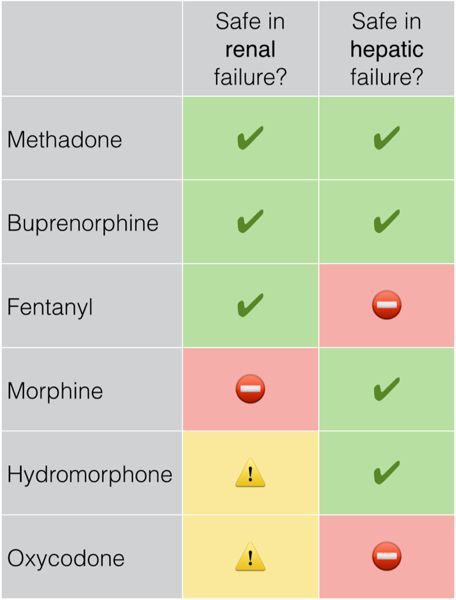
Many times during residency I looked for a table like this online. There weren’t any, so I decided to create one.
Ye’r welcome.
Source: Induru RR, et al. Managing Cancer Pain: Frequently Asked
Questions. Cleveland Clinic Journal Of Medicine. 2011;78(7).
This has become the mantra of every medical student, intern, and
resident wanting to appear smart on rounds and conferences, of every
attending intent on shooting down a team member’s suggestion. Five,
ten years ago it might have have signaled genuine interest. Now
it means, usually, “I don’t know anything about the subject, but I’m
still calling you out on (what I think is) your BS. Here, look at me! I am
evidence-based!”
No, nobody has posed me that question in quite a while, and I don’t
remember ever asking it in any context.
[Note:
Although I understand asking questions means showing
interest, I’ve always preferred looking things up myself. This would
make me appear either very smart or very dumb, depending on whatever
subcontious impression I made on the person in the first few minutes of
us meeting. Try to use the halo effect to your advantage.
] But, honestly,
except for a few very well-known examples listed in this excellent
post, you can find “evidence” in the medical
literature to back up any claim. Off-the-cuff conversations during
lectures and rounds are not the best place to dissect them, especially
when one side has seniority.
Of the three pillars of medicine, research is the most ellusive. Unless you are
in an MD/PhD program—not an option for most Europeans—you will have other
priorities in medical school. And unless your residency program has a built-in
research year, the way most surgical residencies do, you will either be way too
busy in a university or a large community program to do any research, or have
plenty of free time in a lower volume community hospital that doesn’t have many
research opportunities.
When I interviewed residents-to-be last year, my first thought on seeing
a non-PhD applicant having 18 publications on his or her CV wasn’t “Wow,
she is a research machine, we gotta have her”, but rather doubt that anyone
could be that productive during medical school. More points subtracted for
thinking the interviewers would be so gullible.
I graduated six years ago, far enough not to be able to give advice
on how to do research as a medical student. The hows and whys are
institution-specific, so anything I wrote would have to be in Serbian
anyway. Residencies, though, are similar enough to each other that I do
have some words of advice for new residents wanting to do Research! in a
community hospital, university-affiliated or not.
Patient care trumps research. Unless you have already worked as an attending
in another country before coming to the US for residency, don’t waltz in to
your PDs office on day one asking about research opportunities. Prove yourself on
the field first, then six months later, when you’re comfortable managing DVT
prophylaxis, septic shock, and what not, start asking questions.
Get your own idea? Common wisdom says it is better to come up
with your own question and start your own projects, since you will
be more invested in the outcome. Well, yes, sort of. Unless it is a
quick-and-dirty chart review you can do over a two-week vacation—and
even then there are IRB hoops you’d need to jump through to get anything
done—you will get your inexperienced self into the murky world of
project management. Many brilliant ideas have died on the field of
required signatures, ambiguous data points, and impossible-to-coordinate
meetings. Which is why this next advice is important.
Find good mentors. Surrounding yourself with a few good people is orders of
magnitude better than having many good ideas. Research topics come and go, as
does our interest in different fields of medicine (yesterday’s apoptosis is
today’s epigenetics is tomorrow’s something or other). It
is unlikely that the research your started in residency will continue onward
into fellowship, but the knowledge, skills, and general wisdom you pick up from
your mentors should serve you well into your career. NB: don’t wait for someone
to be “assigned” to you—although that’s what many residency programs will
do. Seek out people who match your character and who would be able to give you
advice in at least three fields: patient care, research methodology, and
research topics. This can be one person, or five. And if you find an awesome
mentor who just isn’t doing any research right then, you can always write
a review.
Is it Science! or quality improvement? ACGME is big on Quality! and
Patient Safety! this year. Programs take notice. If you can present your
interest as a quality improvement
project rather than small-s-science, consider doing it. Not only
does showing interest in quality improvement look good on a CV,
your institution might have special funds for resident QI projects.
A dedicated QI mentor is also a good resource, if you want a carreer as a Sith
lor—erm, hospital administrator.
Interest in research goes from I just want something on my CV so I
could get a fellowship to When I grow up, I’ll have my own lab, but
this applies to most people in most circumstances.
Spending two hours each day on the train, offline and without distractions,
gives me an excuse to go down various rabbit holes that a couple of months ago
I would’ve thought nothing but time wasters. Starting to read the Dark Tower
series—I’m almost done with the Gunslinger—is one of them. Re-learning
vim—if dabbling with it in high school 15 years ago counts as having learned
it—is another.
This episode of the Technical Difficulties
podcast
is what started it, followed by a blog
post or
two on the perfect setup.
Now, I may or may not continue using vim as my primary writting tool—I would
have to figure out how to integrate it into my workflow—but several things
I picked up will always be useful:
git is an amazing tool for tracking changes that researchers should use more
don’t blindly edit stuff—dotfiles in this particular case—on your computer
without understanding what those edits mean
Solarized should be your default color theme for anything
use your macro/keyboard shortcut app of choice (mine is Keyboard Maestro, you
can just as easily—but not as prettily—use Better Touch Tools) to quickly
position windows into quadrants, halves, thirds, etc.
there might not be much difference between bash and zsh if you are a beginner,
but zsh has the cool customizable prompts
Yes, I am writing this in vim, previewing and exporting in Marked, then posting
it manually to Squarespace. The only thing standing between me and a fancy-pants
static website engine powering this blog is there being no internet access on
MARC trains, and me being too cheap to get a $20-a-month personal hotspot from
Sprint. That is probably for the best.
4 books read: Ocean at the End of the Lane, Tenth of December, The Golem and the Jinn, Ubiq
2 books re-read: Getting Things Done, Mindfulness in Plain English
1 book half-way through: Embassytown
2 computer games completed: To the Moon, Bastion
3 tabletop games played: Dixit (3 sessions), Pandemic (2), Eldritch Horror (4)
1 used minivan purchased
1 article, 1 abstract submitted
61 km ran
1000+ toddler photos taken
0 tedious field trips made
NIH orientation started today. My commute is 90-plus minutes each way, and the first four months are mostly inpatient. I will have to wait until retirement for another run like this.
The new intern class starts in less than a month. It’s easy enough to find advice on how to be well-organized, efficient, and likable. Here are some more tech-oriented tips I wish I knew back when I started.
Take photos and videos, with permission
Get an iPhone. Turn off Photo stream, or download a camera app that doesn’t automatically upload to it, like VSCOcam. When a physical exam finding is rare, stumps you, or is just cool to see, ask the patient about recording it. If you see an interesting or rare radiography image, save it. But please remove all personally identifiable information.
Useful for: appearing smart on rounds, observing disease course, creating informative slides, posters, and written case reports.
Keep track of things you are interested in
Your EMR will have a way to create custom patient lists. Use it. If you are into hematologic malignancies, eosinophilic esophagitis, MODY—or anything, really—keep track of all your patients who have it. If you don’t yet know what it is, keep a list of all the patients you found interesting and try to find a pattern.
Useful for: getting ideas for research and quality improvement projects, figuring out your career path.
Do not copy forward, copy/paste, or use templates and macros
I started my internship in 2010 so I can’t believe I’ll write this, but—back in the day before EMRs, we wrote our progress notes and H&Ps by hand. This meant reviewing the med list, vital signs, and labs each morning and writing down only the important stuff; completing and recording just those parts of the physical exam that had to be done; and writing a new assessment and plan each day. Well duh, isn’t that what interns should do?—you might naively ask, until your second or third day on the job when a helpful senior resident shows you how to shave minutes—minutes!—off your note-writing time by using some variant of copying forward, templates, or macros.
These tricks are a mental crutch, and a known cause of documentation errors. They might help your handicapped intern self the first few months on the job, but will then prevent you from thinking about what you are doing and writing. A thoughtful daily review of everyone’s medications and labs will turn into a quick glance over a two-page long list of 10-point single-spaced Courier New. Also, your typing speed will never improve if you only document by clicking.
A combination of heavy rain, bad infrastructure, and even worse emergency preparedness
[Note:
No surprise there. This guy is the head of Serbia’s department for emergency response.
] resulted in Serbia and Bosnia having the worst floods in more than a century.
Dozens are dead, and tens of thousands misplaced. Government officials are having nervous breakdowns on live TV, calling the flood “a Biblical catastrophe”—since touting vast water resources as your country’s main asset isn’t a hint as to what big disaster you should prepare for. In case you’re wondering, the Netherlands’ last big flood was in 1953.
And of course a high priest of the Serbian Orthodox Church blamed it on Gay Pride. Because religion.
[Note:
Though I shouldn’t be that sarcastic, since the Orthodox Church is, in fact, trying to help. By praying for the rain to stop.
]
If you have a couple of minutes, please use PayPal to donate to floodrelief@gov.rs, the official account of the Serbian diplomatic mission in Brussels. If your bank allows international wire transfers, you can give directly to the Serbian Red Cross. While no one we know is affected, my grandparents had to leave their home twice over the past 50 years because of floods. The support they and their neighbors received from the Red Cross on both occasions was invaluable.
Fun fact: The average Maryland to DC commute is the second longest in the US, right after New York. I should know. Mine will be 90+ minutes, come July 1st. Last week, while I was finishing paperwork at my new employer’s Bethesda offices, the looks people gave me went from incredulity to pity on seeing the Baltimore address on my driver’s license and hearing my explanation that no, since my wife is still at Sinai and usually just walks to work, we won’t move. It’s better for me to take one for the team, I’d say, than have both of us suffer hellish beltway traffic from some midway point.
I could write an essay on how taking one for the team is not entirely true, but the title of this post says “podcast”, and it’s already the second paragraph, so here is my point: My commute will be long. I will need to fill that time with something. Sometimes, that will be strangers talking into my ear about things I don’t understand. Here is my list of strangers, carefully curated after ten years of listening.
Comes out every Monday morning, like clockwork. Great for learning about new hardware, productivity apps, etc. but podcasts are not the best medium for going into the minutia of somebody’s workflow.
Go read this. Having Merlin Mann talk for an hour all by himself would be good enough, but Dan Benjamin—the other half of BTW—is the best podcast host in the business. By using a simple formula, it is easy to mathematically prove that their show is the best podcast ever created.
The first 30 or so minutes are laden with inside jokes and obscure references, but even that is fun after you are several episodes in.
It airs each Saturday, but I like alliteration, and there is nothing else good on Wednesdays. I was in Chicago once while it was being taped, but was too late to get a ticket. Now that Carl Kasell is retiring, it’s unlikely I’ll ever be at a live show. So it goes…
Daring Fireball is a better blog than TTS is a podcast—John Gruber and some of his guests tend to ramble—but you can get good insights on baseball and bourbon.