For the past three years I have been telling people that Clara Barton — known to you as the founder of American Red Cross, if you know about her at all — needs more screen time. This is not because she was a precocious introvert who learned to read at three, or because she practiced blood-letting via leeches on her convalescing older brother at age eleven, though I can to some extent relate to both. It is purely because, around the corner from our DC condo that bears her name, there is a museum that bears her name: the Clara Barton Missing Soldiers Office Museum.
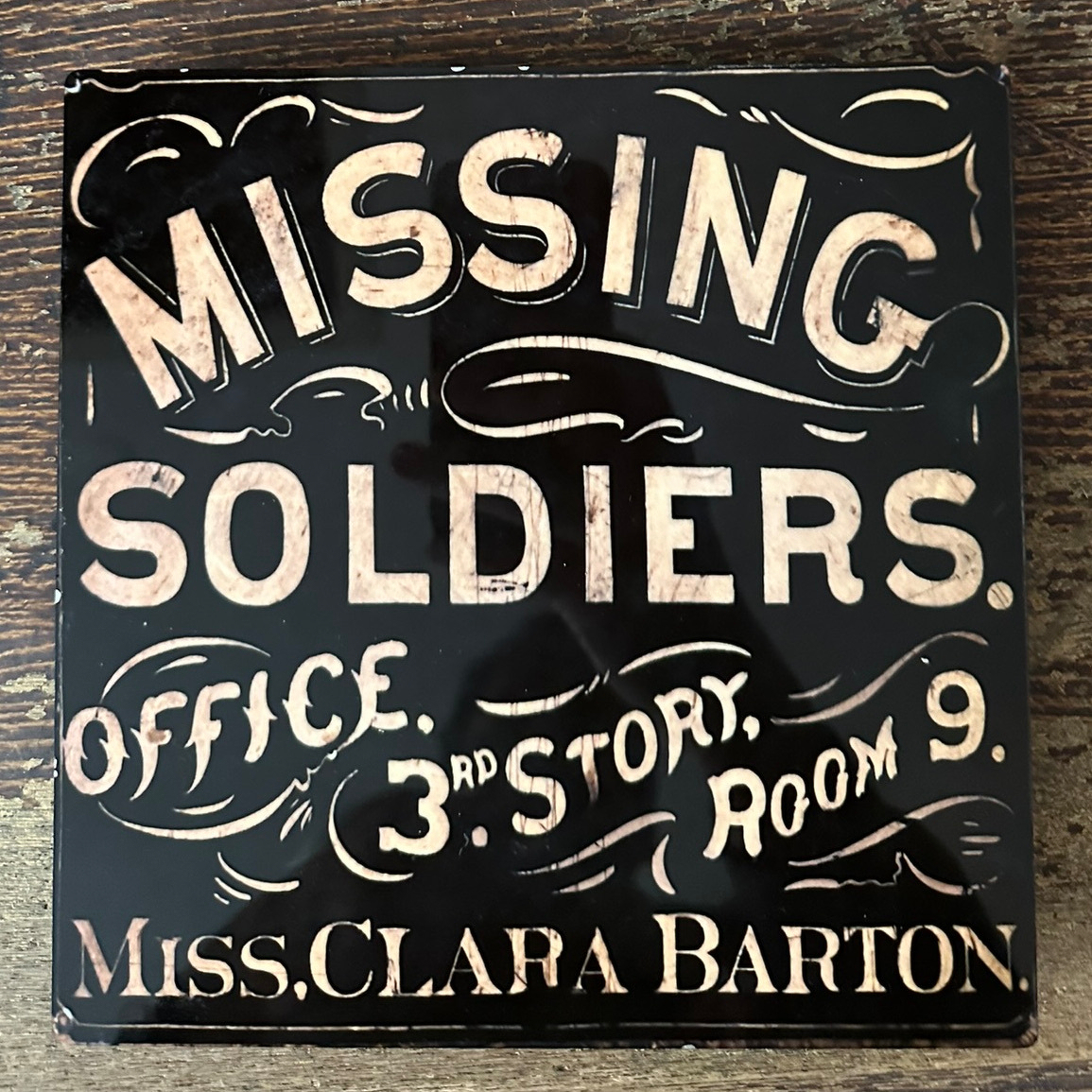
At its doorway is a replica of the Office’s original sign. As of this afternoon I own both a T-shirt and a magnet with this sign, because, well, just look at it.
Replica of the sign, available for purchase at the museum. The original is also in the museum behind a glass case, where even more of yours truly is visible in reflection form. For a clean version of the sign check out the museum website.
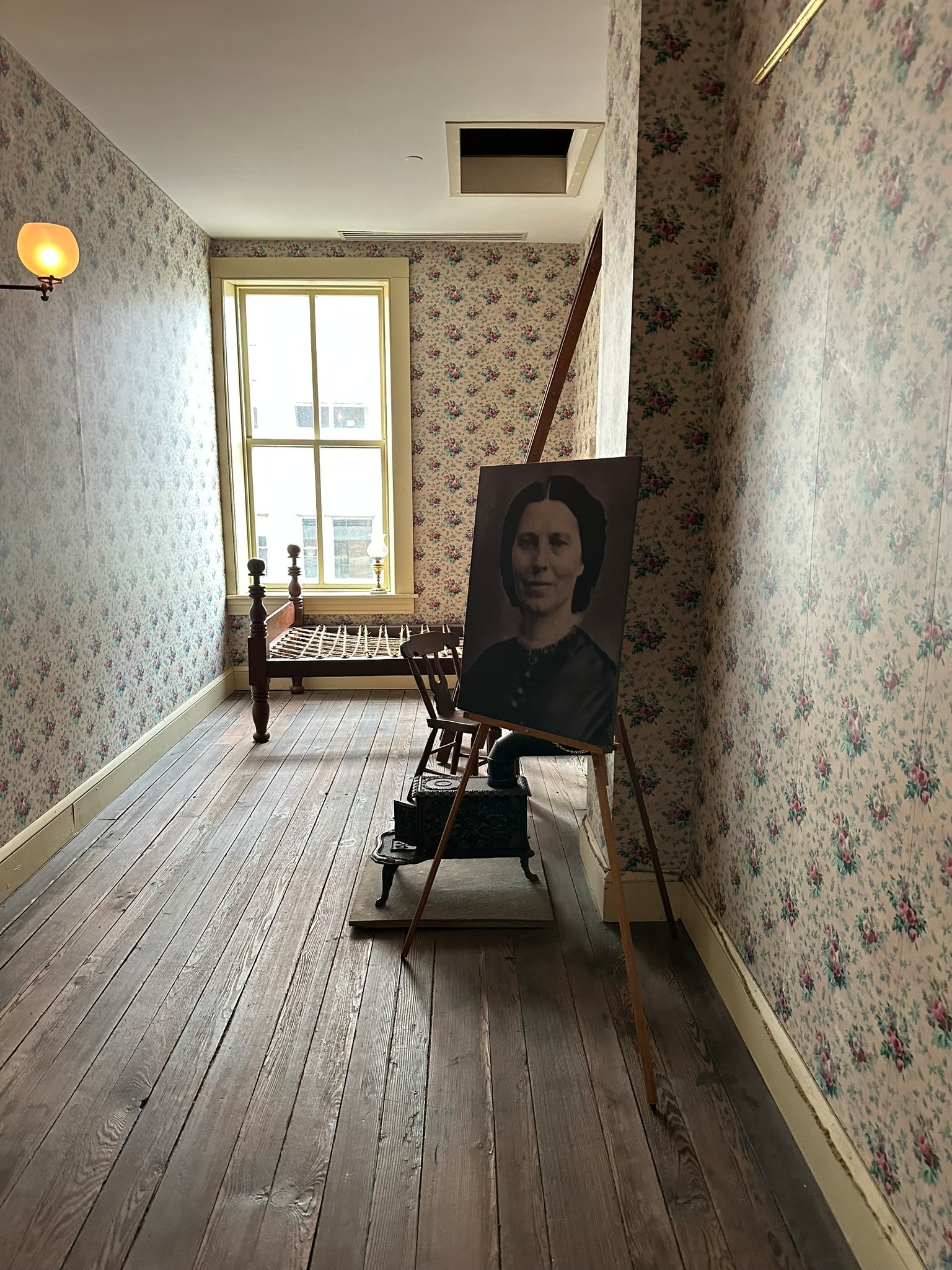
Between the years 1865 and 1868, Ms. Barton used all her free time from the job in the US Patent Office as one of the first five female employees — and the first one paid the same as men — to help families of Civil War soldiers find the fate of their loved ones, all 70,000+ of them who went missing, all having various degrees of literacy, before the phone, telegraph, or even indoor plumbing. The office was the nervous center of the operation that worked as a message exchange, and Barton was the center of the office which she loved so much, that she had her own bedroom narrowed so that the office could expand.
Clara Barton's bedroom. The wall to the left is the one she moved. It was, luckily, not load-bearing, unlike another wall she knocked down for the same purpose to the consternation of her landlord who loved what she did so much that he forgave her.
This is the first angle of the story: a procedural show with one main missing soldier case per episode, several smaller ones in the background. Some of these could be played for comedic relief: not all soldiers wanted to be found and the museum highlighted some interesting correspondence between Barton, a distressed family, and a man who wanted Barton to mind her own business and not have his name plastered all over public notice walls.
The second angle is Barton’s main employer, which is the US Patent Office which is just two blocks north and now houses our favorite Smithsonian museum [Note: Or rather two museums, the National Portrait Gallery and the Museum of American Art. These are also not strangers to strong independent women. ] and which, from 1836 until 1877 housed tens of thousands of miniature models, one for each patent filed. Would Barton had known anyone there? Could any of the patent models have helped her crack a case? Is there a Q of the Bartonverse lurking somewhere in those Greek Revival halls? The mind tingles with the possibilities.
The third angle is the setting. This is Washington DC just after the Civil War. The only cobblestoned street is Pennsylvania Avenue, everything else is dirt central onto which throngs of people empty out their chamberpots while pretending to live in a civil society. This is Clara Barton on Christmas Eve — and the eve of her birthday — in 1861, as tens of thousands of Union Army recruits and ancillary war staff are pouring into town:
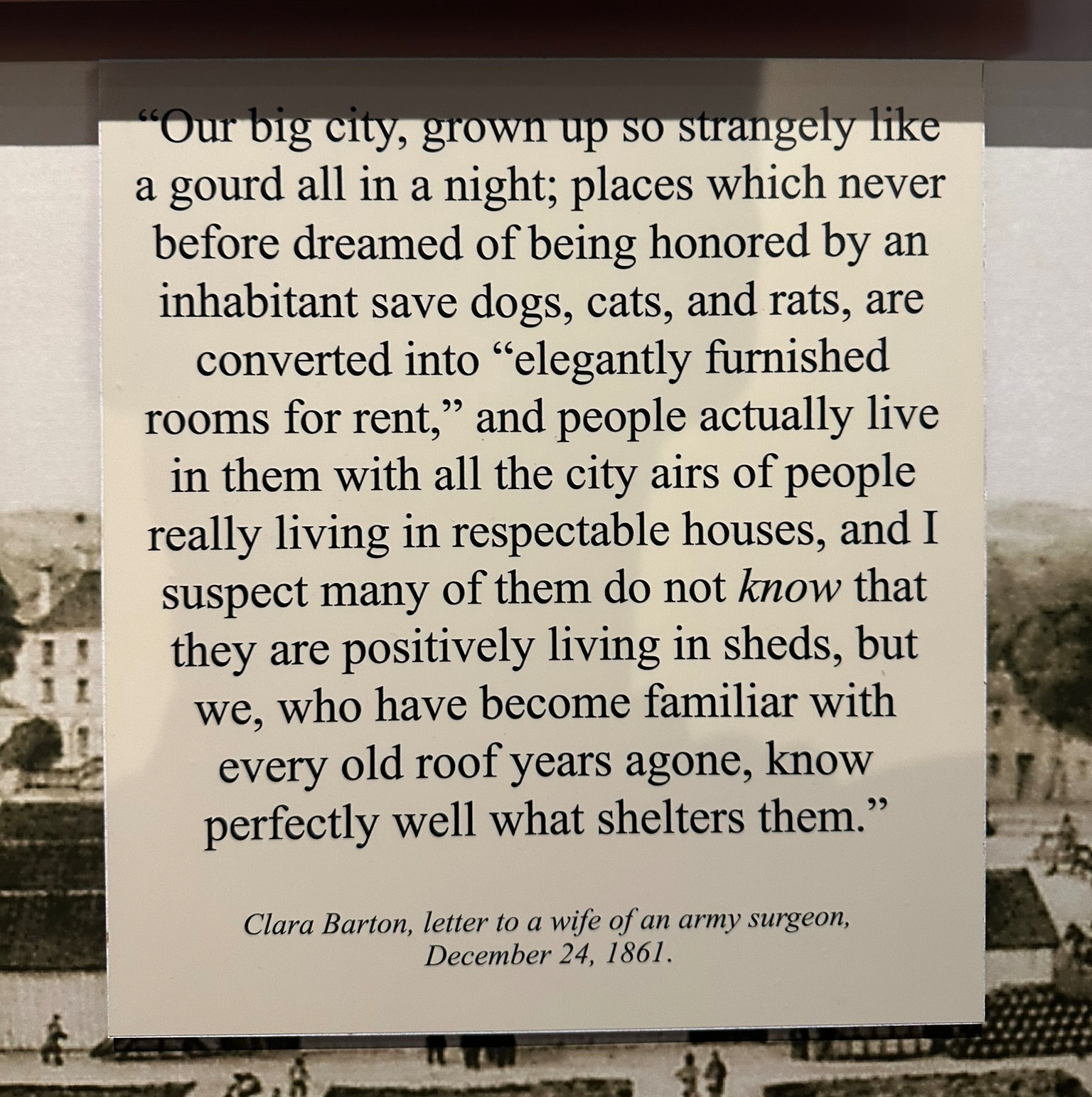 The quote, as seen in the Museum.
Our big city, grown up so strangely like a gourd all in a night; places which never before dreamed of being honored by an inhabitant save dogs, cats and rats, are converted into “elegantly furnished rooms for rent,” and people actually live in them with all the city airs of people really living in respectable houses, and I suspect many of them do not know that they are positively living in sheds, but we, who have become familiar with every old roof years agone, know perfectly well what shelters them.
An observation as valid today about a $4,000 per month row house in Adams Morgan as it was back then about a $7 per month boarding house room further downtown. I am not a fan of today’s issues creeping into (a)historical shows but this is the real deal: an expanding city with murderous architecture, as seen through the eyes of a whip-smart, energetic, ambitious woman.
Of course real life is so much more interesting than any procedural candyfloss could possibly contain. These were only three years in Barton’s life. Before that she created a public school out of nothing only for it to be taken from her and given to a male principal; became one of the first women employees (but not before being fired from the job and then reinstated by Abraham Lincoln); tended to soldiers and coordinated provision of medical supplies to such extent that she was called “the angel of the battle-field”; and seduced a (married) Lt Colonel who continued being so smitten by her that her photo graced the family mantelpiece upon his return. Burnt out after three years spent finding missing soldiers, she went to Europe to recuperate by doctors’ orders only to end up assisting civilians caught in the Franco-Prussian War and learn enough about the Geneva Convention and the International Committee of the Red Cross to proselytize for both upon her return to America, picking up different causes well into her 80s. Exhausted just from typing this, I cannot imagine being the person who lived it. And I can’t wait to read about it in detail.
But wait, there is more. The whole Missing Soldiers episode of Barton’s life was, well, missing from the records, and how we found out about it deserves a sub-plot of its own. As the Capital One Arena — back then the MCI Center — was being built, various speculators tried to cash in on the potential revitalization of the neighborhood. One of them was the United States government, who bought up almost an entire derelict block of warehouses and abandoned storefronts bordered by 6th, 7th, D and E street Northwest in order to flip them to developers. While inspecting one of those properties, a GSA employee called Richard Lyons found a treasure trove of Clara Barton artefacts and realized the building in which they were housed had to be protected.
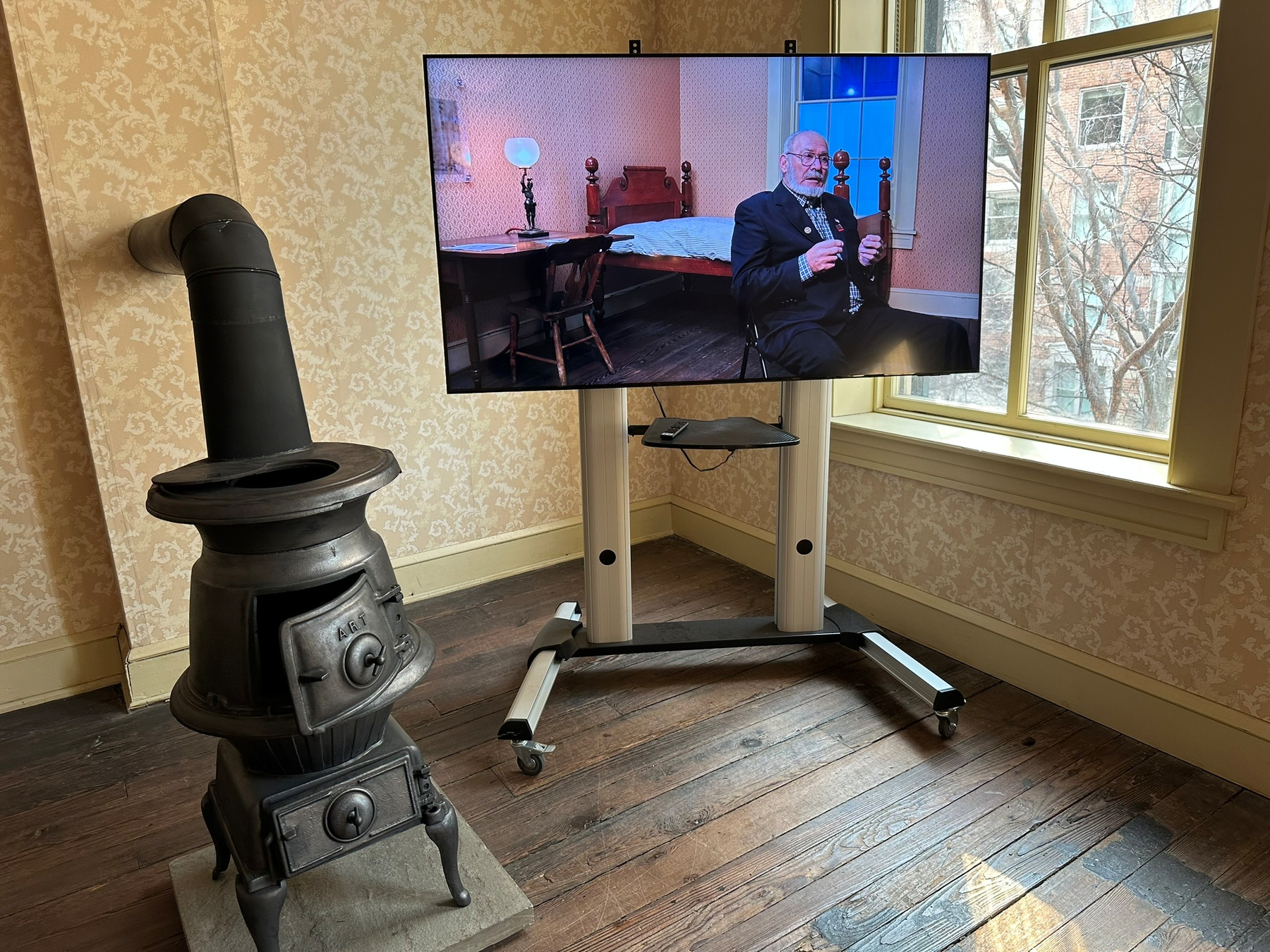 An interview with Lyons is playing on loop in the Museum.
In the HBO show he should be played by Bryan Cranston.
An interview with Lyons is playing on loop in the Museum.
In the HBO show he should be played by Bryan Cranston.
The problem was, he couldn’t just go to his employer and tell them that he shouldn’t be allowed to continue doing his job. At least he was sufficiently afraid of the federal government, back in 1996, to have to devise a different plan. He wrote a letter to the GSA under a pseudonym — Edward Shaw, the landlord — in which he implored them to look into the matter further. And they did! That and several surrounding buildings were reconstructed and preserved, and the office now houses the museum which is itself in care of the National Museum of Civil War Medicine whose wonderful staff provided most of the above information.
Still, it would be nice to have some other museum — looking at you, National Portrait Gallery — have a Clara Barton shelf. Tesla toiled in semi-obscurity for decades, and look at him now. Here is hoping for a similar Barton revival.