Tylerton, Smith Island, Maryland. Yes, that Smith Island.



Craig Mod reviews Oppenheimer:
Strauss and his kangaroo court and Oppenheimer’s philandering all become (quite frankly) sort of meaningless things in the greater context of quantum matter, in the context of splitting the atom, in the context of briefly running a nuclear reactor beneath a football field in Chicago, in the context of somewhat arbitrarily vaporizing a few hundred thousand civilians. I couldn’t but feel heartbreak that the miracle insights of our consciousness (we are the eyes of the universe looking back at itself and all that), the ingenuity of our skull-protected meat-lumps, played a distant second fiddle to (an admittedly well-acted) Downey Jr. as Strauss and his bafflingly pea-sized ego.
Could not have said it better myself, and not for a lack of trying.
The Washington Post’s Andrew Van Dam on the average US doctors' salaries:
The average U.S. physician earns $350,000 a year. Top doctors pull in 10 times that.
I will write more about this later but for now I will just note how frustrating it is to read an article that has a premise and conclusion that I completely agree with (America doesn’t have enough doctors so the ones that it does have are compensated way above average) backed up by mishandled and misreported data (first the article doesn’t say whether the “average” is mean or median — it is the median, which is actually good — then doesn’t explicitly mention that the median in question is of the adjusted gross income at the household level, not of individual compensation: the median total individual income is $265,000).
At least the article linked to the NBER paper with all the data, which in turn completely validated my recent quip about economisits. Frustrating throughout, especially if you try reading the comments.
A tornado warning for DC, and another day of 80mph winds. The one las week was a doozy! What was the micro.blog climate emoji, again? 🧨?
Update: It was fine.
Tylerton, Smith Island, Maryland. Yes, that Smith Island.
🍿 Ruby Gillman, Teenage Kraken (2023) is a better sign of Pixar’s fall from relevancy than their box office bomb that wasn’t (and which, NB, we haven’t seen yet). Ruby…, you see, is one of many recent animated movies influenced by Spider-Verse… for style and The Mitchells… for substance. I would rather have watched either of those for the umpteenth time than Ruby… this once, but it was set under water so the kids liked it.
I’ve been down on D.C. recently so I’d like to make one thing clear: it is a great city to live in, work in, and visit, and don’t let anyone tell you otherwise (you know who they are).
Northern view from the Washington Monument. Note the distinct lack of swamp.

I vaguely remember learning about The Curator’s Code from Marco Arment’s blog and sharing his lack of enthusiasm: I still don’t quite grasp the difference between “via” (ᔥ per the Code) and “hat tip” (↬). But 10 years later, why not give it a shot? ↬Tedium.
By the way, if you — like me — have been wondering why the Brain Pickings RSS feed has gone silent, well wonder no more: two years ago it had a rebrand and is now The Marginalian. Being otherwise preocupied at the time I must have missed it.
And if you’ve never heard of Brain Pickings before, well, you’re in for a treat. ↬Tedium.
Economists are prone to making hypotheses about other fields that make perfect sense to them and others outside of the field, but that can be easily refuted to anyone with an iota of relevant field-specific knowledge. And not just economists. This very sentence is, in fact, one such hypothesis.
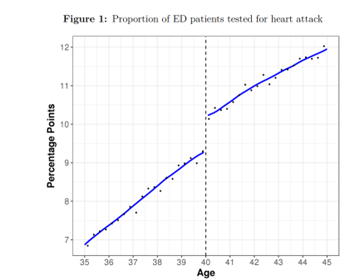
But to get to the point: Alex Tabarrok at Marginal Revolution wrote a post titled Left Digit Bias in Medicine which excerpted his WSJ review of Random Acts of Medicine which is a book about “The Hidden Forces That Sway Doctors, Impact Patients, and Shape Our Health”, which is, believe it or not, part of the title. I hate, hate, hate what book titles have become. This is the literary equivalent of the Amazon product name trash recently discussed on ATP. SEO for books as an externality of Amazon’s dominance — who would have guessed?
Now, I haven’t read the book yet, and the WSJ is behind a paywall, so I only have the excerpt to go by, but it is long and it is sufficient. I won’t quote from it — 4th level of abstraction would be too much — but I will copy the figure and make a few comments. You should read the blog post itself, it is good.
ᔥMarginal Revolution and Random Acts of Medicine