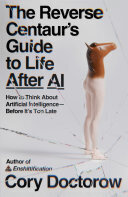
The book is a quick read if you are familiar with Doctorow’s other writings, and/or have listened to a few of his interviews. He is nothing if not consistent and, in the case of AI, consistently correct.
Style
You may, if you feel particularly carmudgeonly, argue that this is a book that could have been a blog post. You would be off by only a degree: each chapter does in fact resemble a piece or three from Pluralistic, his decades-old blog. You may notice that each daily article there starts off with an appropriate picture collage of Doctorow’s own making. “Reverse Centaur’s Guide” is his blog post collage. But he is so good at hiding the seams.
Substance
No arguments there. AI of the day, which is to say LLMs, are a real technology with real uses that is overhyped beyond any reason. Unless Anthropic and/or OpenAI do great a general supper-intelligence — which they won’t — we will witness (if we are lucky) or suffer their fall.
There are now material ways in which LLMs have improved my life.
At work, it is mostly by transcribing the first patient visits so that I can focus on listening to the person in front of me rather than scribbling in a notepad or staring at a screen while nodding my head pretending I am paying attention. [Note: It is not that you get worse at multitasking with age, it is that you realize you were never particularly good at it so you stop pretending. ] Occassionally, for someone recently discharged and with a million notes, tests, and imaging data in the aftermath of their hospitalization, I may use EPIC’s crude but useful built-in summarization tool. I will even use OpenEvidence in preparation for a visit, but I maintain that free and unrestricted search through NCCN, NEJM and JAMA archives would have yielded the same result, and with fewer linguistics tics.
Personally, I have barely moved from my original use case, which was solving household problems. Having installed Meta’s Muse, sandboxed, locked out of any personal information, I do understand agents have their uses:
- Sorting out children’s school emails from two different institutions and for three separate grades and turning them into something actionable.
- Filtering out automated consulting requests and pre-filling answers on availability and general experience.
- Dealing with the administrative wonders that are part of being a small landlord in DC.
In other words, infrastructure-of-life stuff, the exact opposite of what the big mind of Muse espoused. Plans for self-hosting are in progress.
If your reaction to the above was largely negative, you should read the book. Doctorow makes a much better case than I ever could for why it is not morally abhorent to use this new technology. After all, are you boycotting the interstate system because Hitler championed the first autobahn?