When I last wrote about crime in D.C a man was murdered while watching a soccer game right next to my kids’ elementary school. This was back in July. Since then, the murders increased even more in August and decreased to (still high!) 2022 levels in September. Then a congressman got carjacked in front of his apartment building and the news media were all over it.
I mentioned in passing how you can trace a direct line from bad decisions to even worse consequences. While there has been movement to correct some of the more egregious mistakes, I haven’t seen even a suggestion of a mea — or sua — culpa from a council member. Until now!
When the stakes are lower, such as lets say public transit fare evasion, there is more space for assigning responsibility. The press release announcing the new legislation and the history behind the reversal is as good of an example of unintended (but not unforeseen) consequences and externalities as I’ve seen. You could, of course, trace the same well-intentioned path from calls for justice to murders on the soccer field, but that would of course not be so politically palatable.
All of this has reminded me of medical reversals and the unfortunately-titled (but good!) book about ending it. [Note: This is why it is unfortunate: medical reversal is when something that is standard medical practice despite lacking evidence of benefit goes out of fashion once data, usually from a randomized controlled trial, show it doesn’t work. Now, ending reversal could mean two things: that you keep doing the thing despite the new evidence, or that you never start doing the thing to begin with. The authors meant the latter, where my common-sense interpretation is the former. People do dumb stuff. We should promote their reversal. ] Now, “legislative reversal” and “legal reversal” are terms already reserved for when an appeals court overturns a lower court’s decision, so what should we call “medical reversal” for written law? There are plenty of examples: from customs enshrined in old legislation than is then abolished (like traditional medicine disappearing with evidence showing it doesn’t work) to seemingly progressive legislation which is in reality a fountain of unintended consequences becoming quickly reversed.
Whatever the name, the consequences are at least more definitive than with medical reversals, which are rarely full — people still insert intra-aortic balloon pumps and perform kypholasties, I hear — and outside of a full FDA withdrawal of approval never have as clear of a demarcation line as written law. And we shoud strive to promote it, not end it.
A French noun referring to a person, literally meaning “stroller”, “lounger”, “saunterer”, or “loafer”, but with some nuanced additional meanings (including as a loanword into English). Flânerie is the act of strolling, with all of its accompanying associations… Traditionally depicted as male, a flâneur is an ambivalent figure of urban affluence and modernity, representing the ability to wander detached from society with no other purpose than to be an acute observer of industrialized, contemporary life.
Flânerie has been anglicized into flaneuring, a term I first saw when Nassim Taleb described his strolls through Belgrade but which is popular enough to have had its segment on the Today Show, plugging a book that looks like something that I would never in my life touch, but hey, the concept is sound! Take a leisurely walk through the city without a destination or a particular plan. Don’t wear headphones. Do have a partner or two to share your observations.
It is exactly what we have been doing in Honolulu for the last few days and I mentioned off-handedly to my wife the Taleb post and the term. It clicked instantly, like “premium mediocre” did back in the day. What was once premium mediocre has become an unbridled luxury [Note: To keep the Talebian theme going, this is as clear of an example of the Lindy effect as any. ] — thank you, inflation — so we don’t mention the phrase much, but as long as there are cities there will be flaneuring.
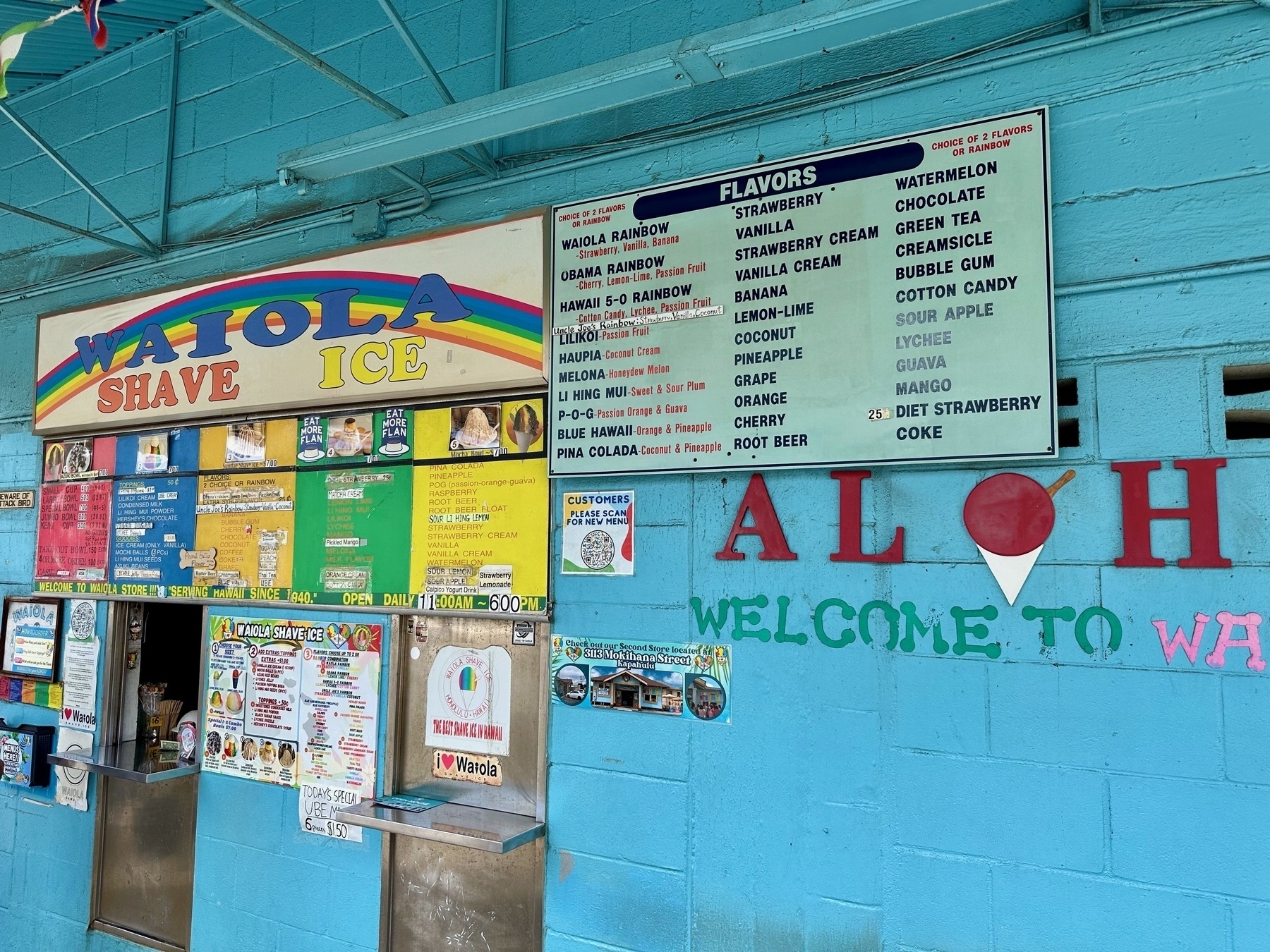
Flaneuring goes hand in hand with good food. This is Waiola Shave Ice, Honolulu, HI.
The non-touristy parts of DC — which is most of them, actually — would probably be in the US Top 5, which is damning with faint praise because the competition is so bad. It is a shame that it wouldn’t be the clear number 2 — with New York being the obvious number 1 — but DC is fairly small, and Chicago is even better for flaneuring than NYC for 3 months of the year. Of course, if we started taking weather into account Honolulu would soon rise to the top and overtake all; but as we are not effective altruists, let’s not.

Accompanying the spouse to a conference is always good, but doubly so when the conference is in Honolulu! There will be a more detailed report after we are back; in the mean time, here are a few murals, from delightful to bizarre.
The last time I attended a large annual meeting of a professional society was in 2019, and either things have taken a strange turn in the last 4 years, or hematology and oncology are so different that attending any other society’s opening session feels uncanny.
I say this because I attended one yesterday — see the other post from today — and if my eyes could have rolled all the way back into my skull, they would have. This is what I am used to: speakers standing behind the podium — usually elevated, sometimes not — looking straight ahead, reading off the teleprompter more or less skillfully — since after all they are doctors and PhDs, not professional salespeople — occasionally averting their gaze in an attempt to connect with the crowd, which is of course impossible because of the glaring stage lights, but all is forgiven because, after all, we are there to learn, not to be entertained.
Well, someone must have come in and told the medicine men they were doing it all wrong, because this session looked like an Apple keynote — the boring parts, where Tim Cook talks about how many stores they opened — crossed with a TED Talk from a dubious but super-enthusiastic liberal arts professor. There is no podium to anchor yourself, so you and your hands are all over the place gesticulating wildly — power-posing, perhaps? — while you gaze into the teleprompter positioned at 45° above the horizon to give you that contemplative look.
This style of presentation is cringy even when most tech companies do it: Apple is Apple; the other big ones don’t even try to compete, and it’s not until you come to the mid to lower-tier [Note: This is a link to the Procreate Dreams reveal video. It is an excellent product which I will definitely get for my kidds to play with, and the creators seem rightfully proud of what they accomplished, but copying Apple did it a disservice. ] that the “person emoting in front of a large professionally-made slide” style re-emerges.
I wish that was all there was to it. Alas, there was a keynote speaker for this openning session of a professional medical society, and the keynote speaker was — it was at this point that I realized the universe was making me pay for coming to Hawaii — a YouTuber! Which is fine, only they decided to set their talk to background music and flashy videos, and pepper it with excerpts from their own content, letting a good personal story of their family and education get drowned in dumb glitz.
Therefore, to be possess’d with double pompe,
To guard a Title, that was rich before;
To gilde refined Gold, to paint the Lilly;
To throw a perfume on the Violet,
To smooth the yce, or adde another hew
Vnto the Raine-bow; or with Taper-light
To seeke the beauteous eye of heauen to garnish,
Is wastefull, and ridiculous excesse.
William Shakespeare, King John, 1623
Four centuries later, we are in full-on gild mode.
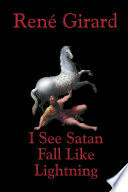
Finished reading: I See Satan Fall Like Lightning by René Girard 📚. It was one of those delightful surprises — much like G.E.B. was last year — that had me double-check my dates: it came out in 1999 but could have been written yesterday. Only, of course, with not nearly as evocative of a title.
It has been sitting on my wish list for a while, as on its surface it resembled too much Joseph Campbell’s The Hero with a Thousand Faces: hunt for similarities between disparate legends, epics, and myths; generalize. I did not much care for that. But after a glowing overview of Girard’s work in Wanting, off the list it went and onto the shelf.
That was a good decision. The comparison to Campbell was unfair: Girard is narrower in focus and more precise in style. The message is not buried under a mountain of anecdote, it’s right there in the introduction: myths are lies people told themselves, blinded by their own viciousness manifest in the process of scapegoating — i.e. mimetic contagion, i.e. the titular Satan — various stories of the Bible shone a light, the light, onto the process, and the world was never the same. Two thousand and some years later people are again eating their own tale, but I am now mixing my myths and becoming an unreliable re-teller — you should read the book for yourself, it is short but punchy.
Last week I went to Bethesda for the NIH hematology/oncology fellowship’s “career panel”. They didn’t have those back in my day so I can’t attest to their value for the heme/onc fellows, but I learned a lot! One interesting tidbit noted by a panelist: academia emphasizes owning the idea, industry emphasizes owning the execution.
📚 I Am a Strange Loop was quite a bit more personal than G.E.B. (about which I wrote a one-sentence blurb here; it is due for a proper review, after a re-read), and it’s easy to pile on Hofstadter since he’s made himself so vulnerable, but there are moments when he is way off base. Yes, there is a something to the analogy between the sense of selfhood and a self-referential (“strange”) loop, and yes different animals have different levels of self-perception, but no, I would not hail Mother Theresa as the pinnacle of humanity, nor Martin Luther King, Jr. for that matter: sorting people’s souls by a single metric is a slippery slope.
The second issue is with his idea of our own loops containing those of others, and people’s identity persisting in others’ minds. That is true only to the extent that other people 1) know themselves, and 2) let others learn what they know about themselves, and not many would pass through both filters.
Dave Winer (@dave) is right, except for one thing: X should have enabled inline links to go alongside the walls of text. I never did care for Twitter cards, but how can you have an interNET without links? Mastodon and Threads, inexplicably, have the same problem.
📺 Season 3 of Only Murders in the Building was their best one yet; I wrote as much last week. Meryl Streep deserves all the awards, Martin Short was at his best, even Paul Rudd was tolerable. The mystery itself was better set up than last year’s, which had too many last-minute revelations for my taste.
If there is one nit to pick it is this: ever since Game of Thrones started going all-out in the second to last episode, actual season finales of many shows have become anti-climactic. The Afterparty is a much bigger offender there, but Murders… do suffer from the same ailment, especially since the last few episodes before the finale itself were so over-the-top good.
Today’s episode of Conversations with Tyler with the historian of the Renaissance Ada Palmer shoots straight to the top of this year’s best-of list for any podcast. Here is a long excerpt to whet your appetite:
Imagine for a moment that you are the French ambassador, and you’re on your way to Rome to meet with the pope because the French king always needs this. Now, if you’re an ambassador, you’re, at minimum, the son of a count because only aristocracy can be ambassadors. On your way south, you’re stopping off in different cities, including Florence.
Now, you already have a terrible opinion of Florence because Florence is a pit of merchants, scum, and villainy. Florence, in order to prevent noblemen from taking over the republic, literally executed everyone in this city who had a drop of royal blood or noble blood. So, it’s just commoners. There’s not a single person in this city who is of sufficient right to be worthy to talk to you. In addition, Florence has such a terrible reputation for sodomy, homosexuality, and perversion that the verb to Florentine is literally the word for anal sex in five different European countries, including in France.
So, you’re on your way to this city, and it’s full of merchant scum and they’re all perverts and there isn’t even anyone there who’s worthy to host you on the way. You’re going to stay with your dad’s banker because he’s the only Florentine whose address you’ve got. You show up in the city, and you reach the city, and suddenly, wait a minute, it’s full of these gorgeous ancient Roman bronzes. Wait a minute, they can’t be ancient Roman bronzes. They look like they’re new, but that technology doesn’t exist. That technology was lost centuries ago.
Then you go to the banker’s house, and he greets you humbly at the door saying, “I’m sorry, my house is unworthy to host your excellency,” and he invites you inside, and you look around the courtyard, and it’s like nothing you’ve ever seen before, with these round circular arches that let enormous amounts of light shine in on the gardens and the statues. You’ve never seen this before. Wait, you have seen this before. It looks like the ruins of the Roman villa in the backyard of your father’s castle where you grew up, but that doesn’t exist anymore. Those arts were lost.
In the middle of the courtyard, there’s a gorgeous statue, an ancient Roman statue of Bacchus or Dionysius, and next to it, there’s a brand-new statue that’s obviously new because it hasn’t even turned green yet. The bronze is still ruddy. But that technology, you know, doesn’t exist.
In the corner, there are some men dressed in strange robes speaking a language you’ve never heard, and you say, “What language are they speaking?” The banker says, “Oh, they’re speaking Ancient Greek. They’re Plato scholars.” And you say, “But Ancient Greek is lost, and Plato is lost. How do you have this?” “Oh, we have lots of Ancient Greek here. Look, here’s my grandson, Lorenzo. He’s just written a sonnet in Ancient Greek about the three parts of the soul.” And then, here’s a little boy reciting a sonnet to you about the nature of the soul in Ancient Greek.
You’re like, “Where am I? All of this stuff is impossible.” And that’s the moment that your host, Cosimo de’ Medici, turns to you and says, “Would France like to make an alliance with Florence?”
You should listen to any podcast with attention to get the most out of it, but this one actually does deserve your fullest attention. Pull to the side of the road if you have to, or else just read the transcript.
And she writes Hugo-nominated science fiction? Ada Palmer is the Renaissance woman.
Update: Of course that she would have a blog: Ex Urbe. Though points deducted for not having posted anything in almost a year.