A missed parenthesis obliterating all reference-style markdown links in this post along with other people’s attempts, good and bad, finally pushed me to add a proofreading step before hitting C-c C-c in Microbe. In the latest version, a C-c C-p will send the draft post to Gemini 2.5 Flash with this prompt:
[Note:
The prompt itself was, of course, suggested by Gemini 3.1 Pro, as was all of the actual LISP code to implement proofreading.
]
You are a strict, technical copy-editor. Your ONLY job is to fix spelling mistakes, typographical errors, and invalid Markdown and Hugo shortcode syntax. You MUST NOT alter the author’s voice, style, phrasing, vocabulary, or structural choices. Output ONLY the corrected text. Do not add conversational filler, introductions, or explanations.
The main reason for the step were annoying shortcode mistakes that would lead to mangled posts, or even more often posts not even making it through Micro.blog’s build leading to minutes (minutes!) spent digging through error logs. But of course there were many, many more spelling mistakes. Last week’s Clara Barton post alone had a whopping 14!
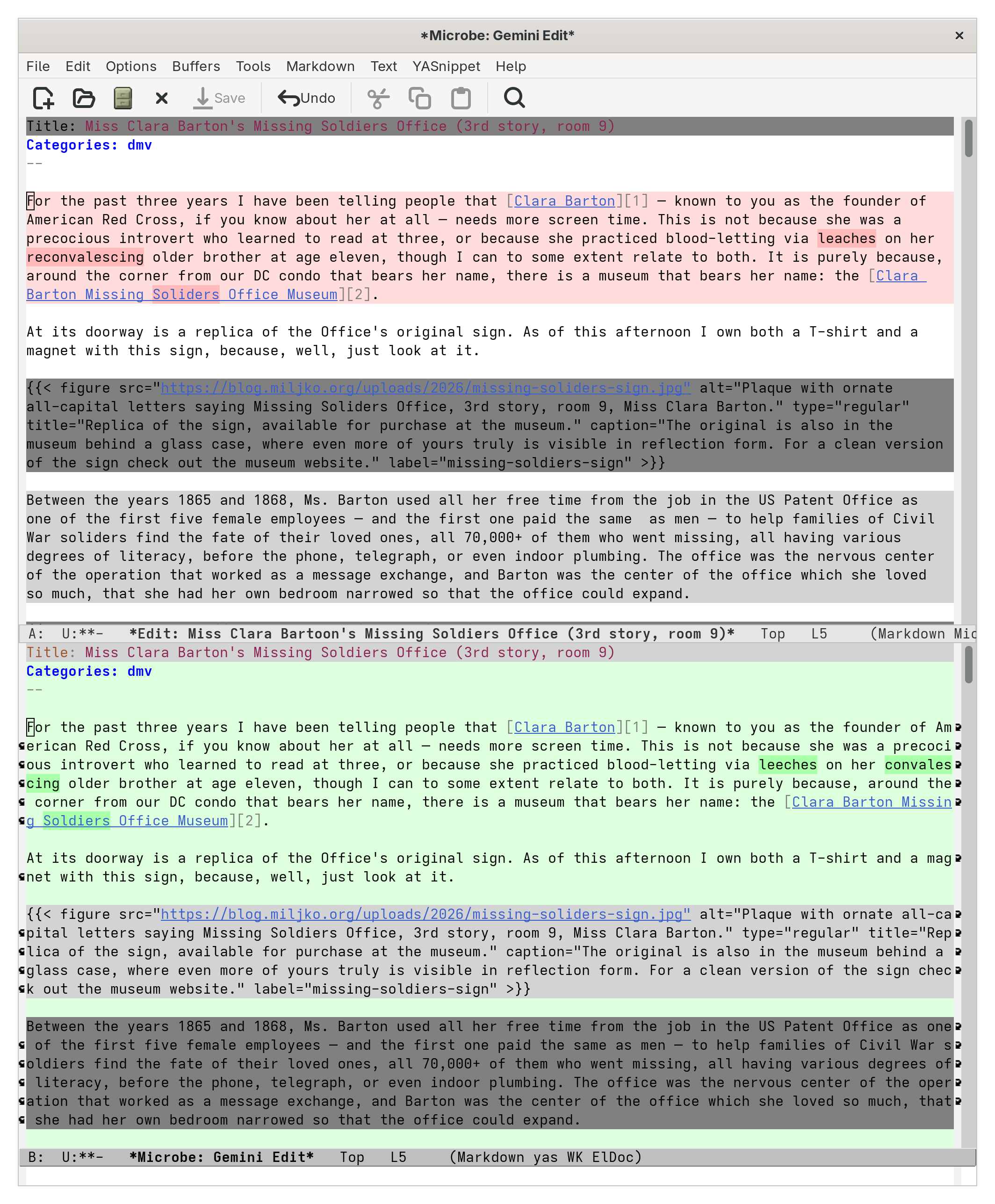 So much red…
Whatever Gemini sends back, Emacs shows in split-screen view with errors in the old text marked in red and the new and improved version marked below in green. For each change, an a accepts and a d declines the suggestion. Easy!
Having said goodbye to Google years ago I can see the irony in picking Gemini to be my go-to LLM and at some point I will switch to an offline model, Doctorow-style. Until then, Gemini is it, thanks to the blandness of Google and its reliability (and it is saying something about the competition when the master of killing services for no good reason is reliable by comparisson).